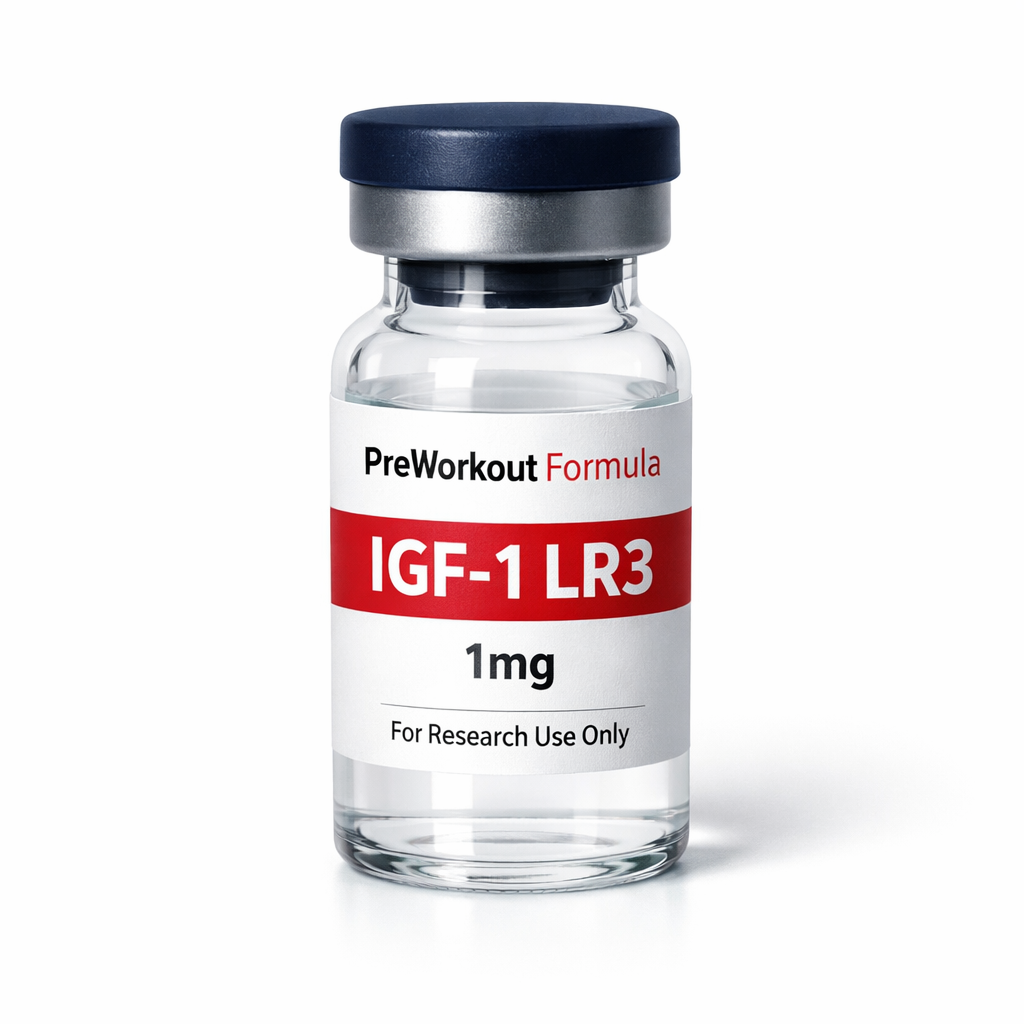
IGF-1 LR3
$69.99
IGF-1 LR3 — engineered insulin-like growth factor with ~100x reduced IGFBP binding and 20-30 hour functional half-life. 2-3x more potent than native IGF-1 at the receptor. 99%+ purity, HPLC verified.
Description
IGF-1 LR3: The Engineered Growth Factor With 2-3x the Potency of Native IGF-1
Native IGF-1 has a problem. It binds to IGF binding proteins (IGFBPs) within seconds of entering circulation. Six different binding proteins sequester it, regulate its bioavailability, and limit its effective half-life to roughly 10-12 minutes in free form. For researchers studying IGF-1 receptor (IGF-1R) signaling, that’s a nightmare — most of your compound is tied up in protein complexes before it reaches the receptor.
IGF-1 LR3 was engineered to solve exactly that. Francis et al. (1992, Journal of Molecular Endocrinology) described the modification: an arginine-to-glutamate substitution at position 3, plus a 13-amino-acid N-terminal extension sequence. These changes reduce IGFBP binding affinity by roughly 100-fold while preserving full IGF-1R activation. The result is a growth factor that stays free in circulation, reaches target receptors efficiently, and maintains a functional half-life of 20-30 hours.
Same receptor. Same signaling cascade. Dramatically different pharmacokinetics.
IGF-1R Signaling — What Happens Downstream
IGF-1 LR3 binds the IGF-1 receptor tyrosine kinase with affinity comparable to native IGF-1. Receptor autophosphorylation triggers two major intracellular cascades:
PI3K/Akt/mTOR pathway: The primary anabolic signaling axis. Akt phosphorylation activates mTORC1, which drives protein synthesis via p70S6K and 4E-BP1. This is the pathway responsible for muscle protein synthesis, cell growth, and anti-apoptotic signaling. Rommel et al. (2001, Nature Cell Biology) mapped the direct connection between IGF-1R → Akt → mTOR → skeletal muscle hypertrophy.
RAS/MAPK/ERK pathway: Drives cellular proliferation and differentiation. Particularly relevant in satellite cell activation, wound healing research, and developmental biology models.
Both pathways fire simultaneously upon IGF-1R activation. The extended bioavailability of LR3 means sustained receptor engagement — not a brief pulse like native IGF-1 delivers.
The IGFBP Evasion Advantage
This is the core innovation. Native IGF-1 in circulation is >95% bound to IGFBPs at any given time. IGFBP-3 alone sequesters about 80% of total circulating IGF-1. Only the free fraction — less than 5% — is biologically active at the receptor.
IGF-1 LR3’s structural modifications reduce IGFBP binding by ~100x. In practical terms: nearly all of the administered compound remains in bioactive free form. Ballard et al. (1996, Growth Regulation) quantified this — LR3 showed 2-3x the mitogenic potency of equimolar native IGF-1 in cell-based assays, directly attributable to its IGFBP evasion.
Specifications
| Parameter | Detail |
|---|---|
| Molecular Formula | C400H625N111O115S9 |
| Molecular Weight | 9,117.5 g/mol |
| Structure | 83 amino acids (70 native + 13 N-terminal extension) |
| Key Modification | Arg3 → Glu3 + 13-aa extension |
| Functional Half-Life | ~20-30 hours |
| IGFBP Binding | ~100x reduced vs. native IGF-1 |
| Purity (HPLC) | ≥99% |
| Storage | Lyophilized, -20°C recommended |
| Reconstitution | 0.1M acetic acid or bacteriostatic water |
Research Context: Where IGF-1 LR3 Fits in the GH Axis
Growth hormone doesn’t build tissue directly. GH hits hepatocytes, which produce IGF-1, which then drives anabolic signaling at target tissues. IGF-1 is the effector molecule. Every GH secretagogue — CJC-1295, Ipamorelin, GHRP-6, the CJC-1295/Ipamorelin blend — ultimately works by increasing IGF-1 levels through this hepatic cascade.
IGF-1 LR3 bypasses that entire upstream pathway. Direct receptor activation, no pituitary or liver intermediary. For research questions about IGF-1R signaling specifically, this is the cleaner tool. For questions about the full GH → IGF-1 axis, the secretagogues are more appropriate.
Tomas et al. (1998, Journal of Endocrinology) used IGF-1 LR3 to demonstrate protein-sparing effects during catabolic states in rat models — effects that occurred at lower doses than required with native IGF-1, consistent with the IGFBP-evasion mechanism extending effective tissue exposure.
What Ships to Your Lab
Each vial contains lyophilized IGF-1 LR3 at 99%+ purity verified by third-party HPLC and mass spectrometry. Due to the larger molecular size (9.1 kDa), proper reconstitution protocol is critical — add solvent slowly along the vial wall, do not vortex. COA included.
Price: $69.99 per vial
Frequently Asked Questions
What is the difference between IGF-1 and IGF-1 LR3?
IGF-1 LR3 has two structural modifications: an Arg3→Glu3 substitution and a 13-amino-acid N-terminal extension. These reduce binding to IGF binding proteins by ~100x, resulting in 2-3x greater biological potency and a functional half-life of 20-30 hours vs. ~12 minutes for native IGF-1.
How does IGF-1 LR3 relate to growth hormone research?
IGF-1 is the downstream effector of GH signaling. GH stimulates hepatic IGF-1 production, and IGF-1 drives anabolic effects at target tissues. IGF-1 LR3 allows direct IGF-1R activation without requiring upstream GH stimulation, which is useful for isolating receptor-specific effects.
What signaling pathways does IGF-1 LR3 activate?
Two primary cascades: PI3K/Akt/mTOR (protein synthesis, cell survival, growth) and RAS/MAPK/ERK (proliferation, differentiation). Both pathways activate simultaneously upon IGF-1R engagement.
How should IGF-1 LR3 be reconstituted?
Use 0.1M acetic acid or bacteriostatic water. Add solvent slowly along the vial wall — do not vortex or shake vigorously, as this can denature the 83-amino-acid protein. Gentle swirling is sufficient.
What is the half-life of IGF-1 LR3?
Functional half-life is approximately 20-30 hours, compared to ~12 minutes for free native IGF-1. The extended duration is due to reduced IGFBP sequestration, not structural resistance to proteolysis.
Can IGF-1 LR3 be studied alongside GH secretagogues?
Yes. Researchers often compare direct IGF-1R activation (via IGF-1 LR3) against indirect activation (via GH secretagogues like CJC-1295 or Ipamorelin) to differentiate GH-dependent vs. GH-independent IGF-1 effects.
Where can I buy IGF-1 LR3 for research?
PreWorkout Formula supplies IGF-1 LR3 at 99%+ purity with full COA documentation. View our complete catalog at peptides for sale.
What is the molecular weight of IGF-1 LR3?
Approximately 9,117.5 g/mol. It’s a substantially larger peptide than most GH secretagogues, which is why careful reconstitution protocol matters.
Related Research Peptides
- CJC-1295 — GHRH analog that drives IGF-1 production through the GH axis
- Ipamorelin — Selective GH secretagogue for upstream IGF-1 modulation
- CJC-1295 / Ipamorelin Blend — Synergistic GH stimulation for maximum IGF-1 output
- GHRP-6 — Broad GH secretagogue for full ghrelin-pathway research
- BPC-157 — Tissue repair peptide with potential GH/IGF-1 pathway interactions
- TB-500 — Thymosin beta-4 fragment for regenerative medicine research
This product is intended for laboratory and research use only. Not for human consumption. All buyers must be qualified researchers or institutions. By purchasing, you agree to use this product solely for legitimate research purposes.