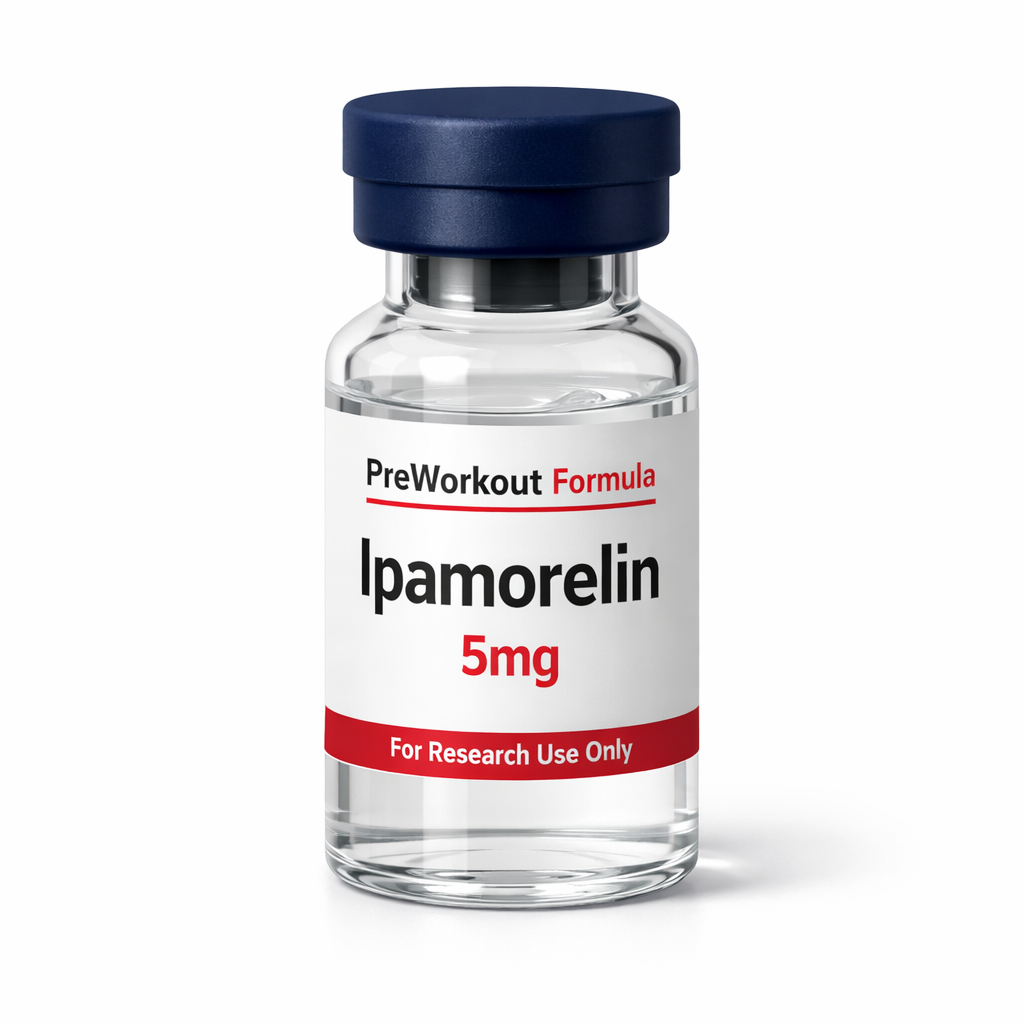
Ipamorelin
$39.99
Ipamorelin — the most selective GH secretagogue ever developed. Potent GH release without cortisol, prolactin, or appetite side effects documented in published research. 99%+ purity, HPLC verified.
Description
Ipamorelin: The Most Selective Growth Hormone Secretagogue Ever Synthesized
Most GH secretagogues are messy. GHRP-2 spikes cortisol. GHRP-6 triggers ravenous hunger through ghrelin pathway crosstalk. Hexarelin desensitizes its own receptor within weeks. Ipamorelin broke that pattern. First characterized by Raun et al. in 1998 (European Journal of Endocrinology), this pentapeptide demonstrated something researchers hadn’t seen before — potent, dose-dependent GH release with virtually zero effect on ACTH, cortisol, prolactin, or appetite signaling.
Five amino acids. Clean GH release. No metabolic noise.
The Selectivity Problem Ipamorelin Solved
Every GH secretagogue before Ipamorelin came with baggage. The ghrelin receptor (GHS-R1a) sits on multiple cell types — not just pituitary somatotrophs. Activate it broadly and you get downstream effects on adrenal corticotrophs (cortisol), lactotrophs (prolactin), and hypothalamic appetite centers (hunger). GHRP-6 hits all of them.
Ipamorelin binds GHS-R1a on somatotrophs with high affinity but shows negligible activation of those secondary pathways. The Raun 1998 data is striking: at GH-maximizing doses, cortisol and prolactin remained at baseline. No other synthetic secretagogue in the literature achieves that separation.
Anderson et al. (2001, Journal of Clinical Endocrinology & Metabolism) confirmed this selectivity in human subjects. Single IV doses of 0.01-0.1 mg/kg produced robust GH peaks within 30-45 minutes. Cortisol? Flat. Prolactin? Flat. The dose-response curve for GH was clean and linear.
Mechanism of Action
Ipamorelin is a ghrelin mimetic — it activates the growth hormone secretagogue receptor (GHS-R1a) on anterior pituitary somatotrophs. This triggers intracellular calcium influx via the phospholipase C / IP3 pathway, which drives GH vesicle exocytosis.
Critical detail: Ipamorelin works within the somatostatin rhythm. GH is released in pulses, not a sustained flood. Somatostatin still gates the release, meaning the peptide amplifies natural secretory patterns rather than overriding them. This is fundamentally different from injecting recombinant GH, which bypasses pituitary regulation entirely.
Specifications
| Parameter | Detail |
|---|---|
| Molecular Formula | C38H49N9O5 |
| Molecular Weight | 711.85 g/mol |
| Sequence | Aib-His-D-2-Nal-D-Phe-Lys-NH2 |
| Half-Life | ~2 hours |
| Purity (HPLC) | ≥99% |
| Storage | Lyophilized, -20°C recommended |
| Reconstitution | Bacteriostatic water |
Research Context: Why Ipamorelin Dominates GH-Axis Studies
The selectivity profile makes Ipamorelin the default choice for isolating GH-specific effects in research. If you’re studying GH’s role in lipolysis, protein synthesis, bone metabolism, or tissue repair — and you use GHRP-6 instead — your cortisol variable is now confounded. Ipamorelin removes that problem.
Researchers studying the GH/IGF-1 axis frequently pair Ipamorelin with CJC-1295 (a GHRH analog). The rationale: GHRH-R and GHS-R1a activation together produces synergistic GH output — documented at 2-3x the response of either peptide alone. The CJC-1295 / Ipamorelin blend exists specifically to streamline that protocol.
Hansen et al. (2005, European Journal of Endocrinology) also explored Ipamorelin’s effects on bone markers in ovariectomized rat models. Twelve weeks of administration produced significant increases in bone mineral content and periosteal bone formation — effects consistent with GH-mediated osteoblast stimulation without the confounding cortisol elevation that other secretagogues introduce.
What Ships to Your Lab
Each vial contains lyophilized Ipamorelin at 99%+ purity, verified by third-party HPLC and mass spectrometry. Sealed under inert gas, shipped with desiccant pack. Certificate of analysis included with every order.
Price: $39.99 per vial
Frequently Asked Questions
What makes Ipamorelin different from other GH secretagogues?
Ipamorelin is the most selective GHS-R1a agonist available. Unlike GHRP-6 or GHRP-2, it does not significantly elevate cortisol, prolactin, or appetite signaling at GH-maximizing doses. This selectivity is documented in Raun et al. (1998) and confirmed in human trials by Anderson et al. (2001).
What is the half-life of Ipamorelin?
Approximately 2 hours. GH peaks typically occur 30-45 minutes post-administration, with levels returning to baseline within 3-4 hours.
Does Ipamorelin cause hunger like GHRP-6?
No. GHRP-6 stimulates appetite through broader ghrelin receptor activation. Ipamorelin’s selectivity for somatotroph GHS-R1a means minimal appetite signaling in research models.
Can Ipamorelin be used with CJC-1295 in research protocols?
Yes. The combination of a GHRH analog (CJC-1295) with a GHS (Ipamorelin) produces synergistic GH release — amplifying output beyond what either compound achieves alone. The pre-mixed blend is available for convenience.
How should Ipamorelin be reconstituted and stored?
Reconstitute with bacteriostatic water. Store lyophilized vials at -20°C. After reconstitution, refrigerate at 2-8°C and use within 3-4 weeks.
What purity does PreWorkout Formula’s Ipamorelin have?
Every batch is third-party tested at ≥99% purity via HPLC. Mass spectrometry confirms molecular identity. COA ships with your order.
Where can I buy Ipamorelin for research?
PreWorkout Formula stocks Ipamorelin year-round with fast shipping. See our full catalog on the peptides for sale page.
What is the molecular weight of Ipamorelin?
711.85 g/mol. The peptide sequence is Aib-His-D-2-Nal-D-Phe-Lys-NH2 — a pentapeptide with non-natural amino acid substitutions for receptor selectivity and stability.
Related Research Peptides
- CJC-1295 — Long-acting GHRH analog, synergistic with Ipamorelin for GH research
- CJC-1295 / Ipamorelin Blend — Pre-combined for dual-receptor GH-axis protocols
- GHRP-6 — Potent but less selective GH secretagogue for comparison studies
- IGF-1 LR3 — Downstream growth factor for IGF-1 pathway research
- BPC-157 — Gastric pentadecapeptide studied for tissue repair
- TB-500 — Thymosin beta-4 fragment for cellular migration research
This product is intended for laboratory and research use only. Not for human consumption. All buyers must be qualified researchers or institutions. By purchasing, you agree to use this product solely for legitimate research purposes.