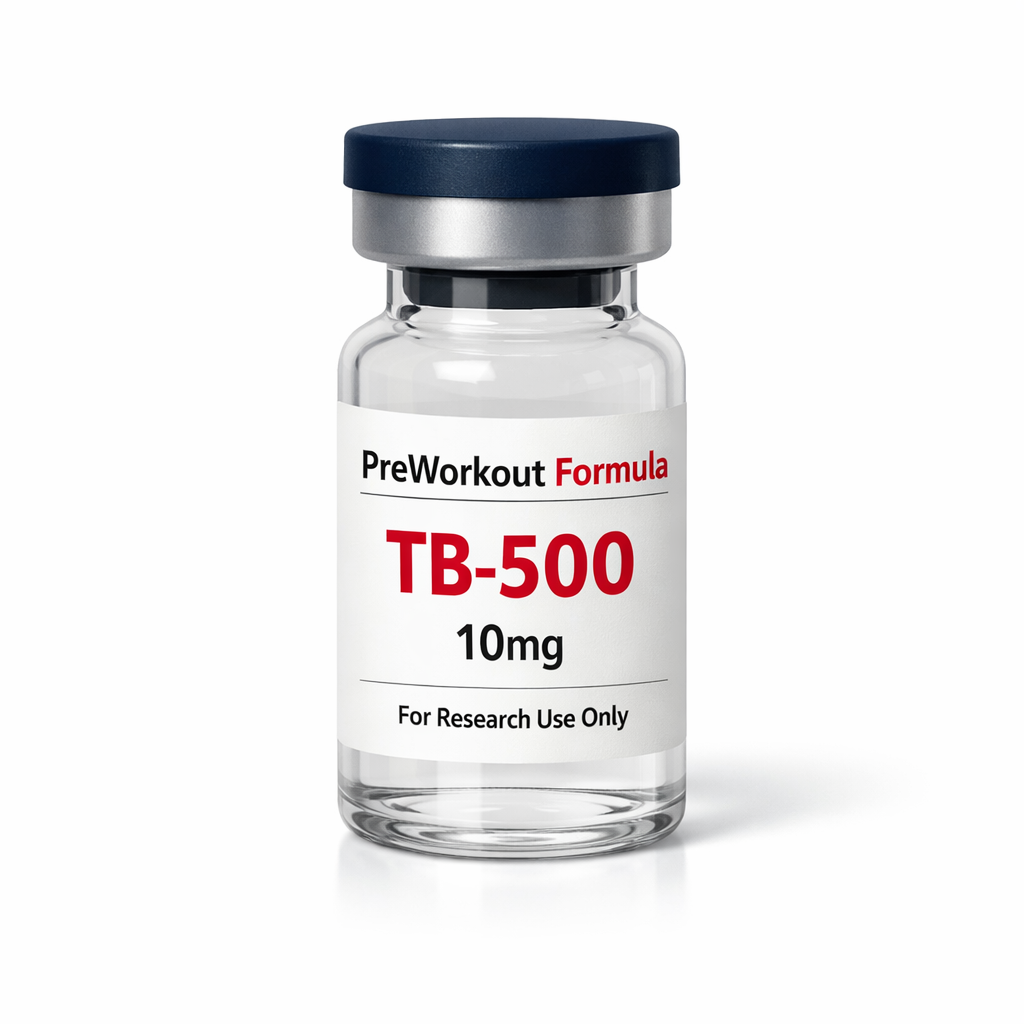
TB-500
$88.00
Synthetic 43-amino-acid Thymosin Beta-4 fragment. 5mg lyophilized powder, ≥99% HPLC-verified purity. Studied for actin regulation, angiogenesis, cardiac tissue repair, and inflammatory response modulation. COA included with every order.
Description
TB-500: Synthetic Thymosin Beta-4 Fragment for Advanced Tissue Research
Thymosin Beta-4 is the most abundant member of a 15-protein family first identified in calf thymus extracts back in 1966. TB-500 — its 43-amino-acid synthetic analog — isolates the active region responsible for the protein’s most studied property: actin binding and cell migration regulation. Over 800 papers reference Thymosin Beta-4 in PubMed, making it one of the most thoroughly documented peptides in regenerative research.
The mechanism isn’t complicated. TB-500 binds to G-actin (globular actin monomers), preventing premature polymerization into F-actin filaments. This upregulates cell motility. Cells move faster to injury sites. Published data from Annals of the New York Academy of Sciences (2007) confirmed this migration effect across multiple cell types — endothelial cells, keratinocytes, and corneal epithelial cells.
Peptide Specifications
| Parameter | Detail |
|---|---|
| Sequence | Ac-SDKP active region (43-amino-acid fragment) |
| Molecular Weight | 4963.50 g/mol |
| Purity | ≥99% (HPLC verified) |
| Form | Lyophilized powder |
| Quantity | 5mg per vial |
| Storage | -20°C prior to reconstitution |
| CAS Number | 77591-33-4 |
Core Research Domains
Angiogenesis and Blood Vessel Formation: TB-500’s most replicated finding. Malinda et al. demonstrated in Journal of Investigative Dermatology (1999) that Thymosin Beta-4 promoted angiogenesis in dermal wound models. The peptide stimulated endothelial cell differentiation into tube-like structures — a hallmark of new vessel formation critical to tissue recovery.
Cardiac Tissue Research: A standout area. Bock-Marquette et al. published landmark findings in Nature (2004) showing Thymosin Beta-4 activated Akt signaling pathways in cardiomyocytes, promoting survival under hypoxic conditions. Subsequent studies explored its role in epicardial progenitor cell activation and cardiac regeneration post-injury.
Inflammatory Response Modulation: TB-500 research has documented suppression of NF-kB signaling and reduction of pro-inflammatory cytokines (IL-1β, TNF-α) in multiple tissue models. Young et al. (Expert Opinion on Biological Therapy, 2004) characterized this anti-inflammatory profile as distinct from corticosteroid mechanisms — operating through cell migration pathways rather than broad immune suppression.
Hair Follicle Stem Cell Activation: An unexpected research direction. Philp et al. reported in FASEB Journal (2004) that Thymosin Beta-4 stimulated hair follicle stem cells, accelerating hair growth in murine models. The finding generated significant interest in dermatological research circles.
Structural Advantages for Research
TB-500’s relatively large molecular weight (4963 Da) gives it systemic distribution properties that smaller peptides lack. Published pharmacokinetic data suggests it circulates widely rather than localizing at injection sites. This systemic reach is why researchers studying multi-tissue injury models gravitate toward TB-500 over more localized compounds.
Each vial includes a certificate of analysis with full HPLC chromatogram and mass spectrometry confirmation.
Reconstitution Protocol
Add 1-2mL bacteriostatic water per 5mg vial. Direct the stream against the glass wall, not the powder cake. Allow 2-3 minutes for full dissolution — TB-500’s larger molecular size means slightly slower reconstitution than smaller peptides. Store at 2-8°C once reconstituted. Stable for approximately 21 days under refrigeration.
Frequently Asked Questions
What is the relationship between TB-500 and Thymosin Beta-4?
TB-500 is a synthetic peptide fragment replicating the active region of naturally occurring Thymosin Beta-4. The full protein was first isolated from thymus tissue. TB-500 contains the specific amino acid sequence responsible for the actin-binding and cell migration properties documented in published research.
Why is TB-500 priced higher than smaller peptides?
Synthesis complexity scales with amino acid count. At 43 amino acids, TB-500 requires significantly more synthesis steps than peptides like BPC-157 (15 amino acids) or KPV (3 amino acids). Each additional coupling step adds cost and reduces overall yield. Maintaining ≥99% purity at this chain length is technically demanding.
What cell types has TB-500 been studied with?
Published studies document effects on endothelial cells, keratinocytes, corneal epithelial cells, cardiomyocytes, hair follicle stem cells, and various immune cell populations. The actin-binding mechanism is universal to cell types that rely on cytoskeletal reorganization for migration.
How does TB-500 differ from BPC-157 in research applications?
Different mechanisms entirely. BPC-157 works primarily through nitric oxide system modulation and shows particular strength in gastrointestinal models. TB-500 operates via actin regulation and cell migration pathways, with its strongest published data in cardiac and vascular research. Many protocols investigate both peptides simultaneously for this reason.
What is the Ac-SDKP sequence and why does it matter?
Ac-SDKP (N-acetyl-seryl-aspartyl-lysyl-proline) is a tetrapeptide within TB-500’s structure that has independent anti-fibrotic activity. Published research in American Journal of Physiology showed Ac-SDKP inhibits collagen deposition — relevant to fibrosis and scarring research.
Can TB-500 be combined with other peptides in research protocols?
Yes. The most common research combination in published literature pairs TB-500 with BPC-157 — different mechanisms of action, no documented interference. Some protocols also include GHK-Cu for its complementary copper-dependent tissue remodeling pathways.
What storage conditions maximize TB-500 stability?
Lyophilized: -20°C, desiccated, protected from light. Stable 24+ months under these conditions. Reconstituted: 2-8°C, use within 21 days. TB-500’s larger molecular weight makes it slightly more susceptible to degradation than shorter peptides once in solution.
Related Products
- BPC-157 — Most commonly paired peptide in tissue repair research protocols
- GHK-Cu — Copper-dependent tissue remodeling peptide with complementary mechanisms
- Sermorelin — Growth hormone secretagogue studied alongside tissue repair peptides
- IGF-1 LR3 — Growth factor with documented synergy in anabolic tissue research
This product is intended for laboratory and research use only. Not for human consumption. All buyers must be qualified researchers or institutions. By purchasing, you agree to use this product solely for legitimate research purposes.