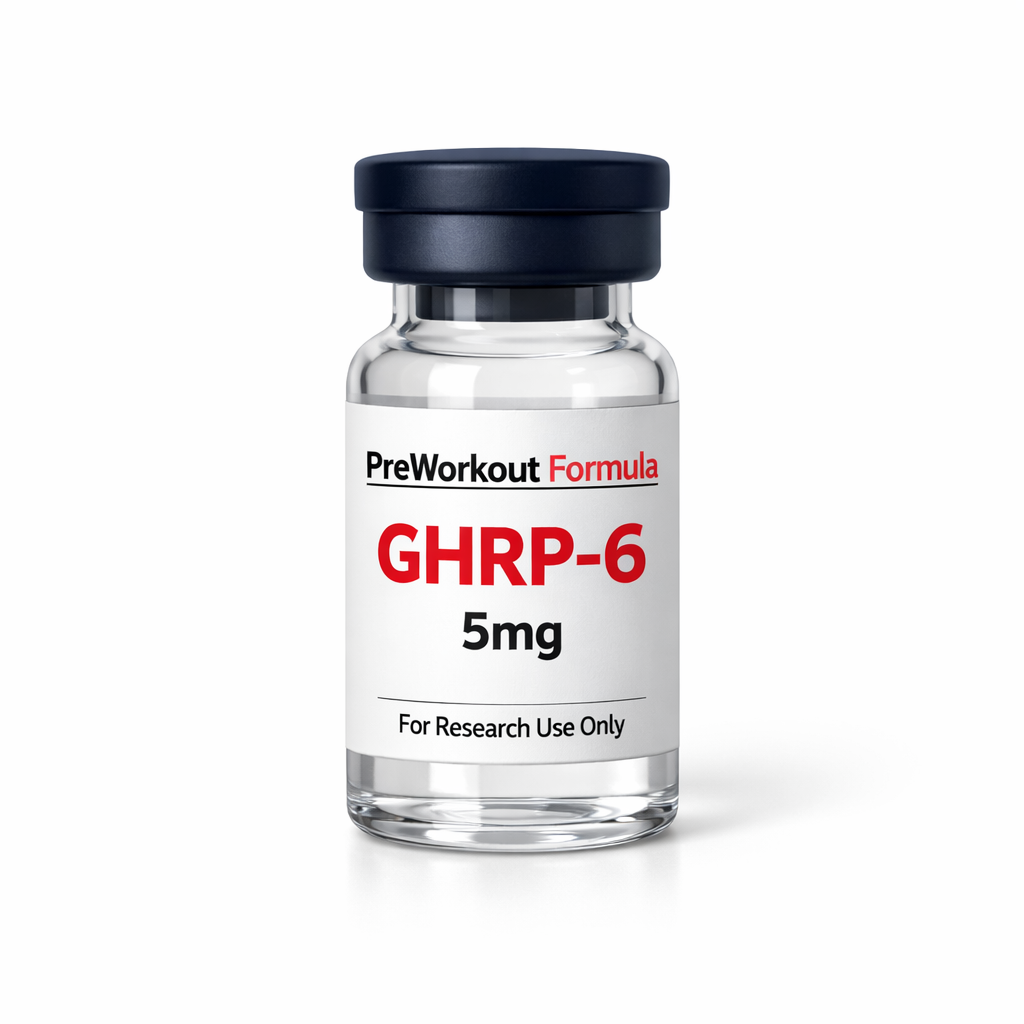
GHRP-6
$29.99
GHRP-6 — the original GH secretagogue, first synthesized by Cyril Bowers at Tulane. Broad GHS-R1a agonist for full ghrelin-system research. 99%+ purity, HPLC verified.
Description
GHRP-6: The Original Growth Hormone Secretagogue That Started It All
Before Ipamorelin existed. Before anyone thought to blend peptides. There was GHRP-6. Synthesized by Cyril Bowers’ lab at Tulane University in the early 1980s, this hexapeptide was the first synthetic compound proven to release growth hormone through a receptor that nobody even knew existed yet. Bowers published the initial characterization in 1984 (Endocrinology), and the field of growth hormone secretagogue research was born from a single unexpected observation — a small peptide fragment that had nothing to do with GHRH could trigger massive GH release from pituitary cells.
The receptor it activated? Unknown for another 12 years. Howard et al. finally cloned GHS-R1a in 1996 (Science). Kojima identified its natural ligand — ghrelin — in 1999 (Nature). GHRP-6 literally led researchers to discover an entirely new hormone system.
Why GHRP-6 Hits Different Than Modern Secretagogues
GHRP-6 is not selective. That’s both its limitation and its research value.
It activates GHS-R1a broadly — somatotrophs (GH release), corticotrophs (ACTH/cortisol), and hypothalamic appetite centers (hunger). A 1997 study by Arvat et al. (Journal of Clinical Endocrinology & Metabolism) showed that GHRP-6 at 1 mcg/kg IV produced robust GH peaks within 15-30 minutes, but also measurable cortisol and prolactin increases. Ipamorelin was later designed specifically to avoid these off-target effects.
But here’s why GHRP-6 still matters in 2026: if your research question involves the ghrelin system broadly — appetite signaling, cortisol interplay, gastric motility, or the full GHS-R1a activation profile — Ipamorelin’s selectivity actually becomes a limitation. You need the broad agonist. You need GHRP-6.
Mechanism of Action
GHRP-6 binds GHS-R1a and triggers the PLC/IP3 pathway, causing intracellular calcium release and GH vesicle exocytosis from anterior pituitary somatotrophs. Same core mechanism as all ghrelin mimetics.
The difference is downstream breadth. GHRP-6 also activates GHS-R1a on:
- Hypothalamic arcuate nucleus neurons — Stimulates NPY/AgRP pathways, driving appetite
- Vagal afferents — Increases gastric acid secretion and gut motility
- Adrenal corticotrophs — Modest ACTH and cortisol elevation
This broad activation profile mirrors what endogenous ghrelin does. GHRP-6 is, functionally, the closest synthetic analog to ghrelin’s full receptor engagement.
Specifications
| Parameter | Detail |
|---|---|
| Molecular Formula | C46H56N12O6 |
| Molecular Weight | 873.01 g/mol |
| Sequence | His-D-Trp-Ala-Trp-D-Phe-Lys-NH2 |
| Half-Life | ~15-60 minutes |
| Purity (HPLC) | ≥99% |
| Storage | Lyophilized, -20°C recommended |
| Reconstitution | Bacteriostatic water |
Published Research Highlights
GHRP-6 has one of the deepest research bibliographies of any synthetic peptide. Over four decades of published data.
Bowers (1998, Journal of Pediatric Endocrinology) demonstrated that combining GHRP-6 with GHRH analogs like CJC-1295 produces synergistic GH output — the same dual-receptor principle behind the CJC-1295 / Ipamorelin blend, but with GHRP-6’s broader activation profile intact.
Berlanga et al. (2007, Journal of Peptide Science) explored GHRP-6 in wound healing models and found accelerated granulation tissue formation and re-epithelialization — effects potentially linked to both GH/IGF-1 signaling and direct tissue-level GHS-R1a activation. This overlaps with research areas typically associated with BPC-157 and TB-500.
Gnanapavan et al. (2002, Clinical Endocrinology) used GHRP-6 as a diagnostic provocative agent for GH deficiency testing, establishing it as a standardized clinical research tool for pituitary function assessment.
What Ships to Your Lab
Each vial contains lyophilized GHRP-6 at 99%+ purity verified by third-party HPLC and mass spectrometry. Sealed under nitrogen, shipped with desiccant. Certificate of analysis included.
Price: $29.99 per vial
Frequently Asked Questions
What is GHRP-6 used for in research?
GHRP-6 is used to study GHS-R1a activation, GH secretion dynamics, appetite signaling, gastric motility, and the broader ghrelin system. It’s also used as a GH provocative test agent for pituitary function assessment.
How does GHRP-6 compare to Ipamorelin?
GHRP-6 is a broad GHS-R1a agonist — it triggers GH release but also elevates cortisol, prolactin, and appetite. Ipamorelin is selective for GH-only release. Choose GHRP-6 when studying the full ghrelin pathway; choose Ipamorelin when isolating GH-specific effects.
Does GHRP-6 increase appetite?
Yes. GHRP-6 activates hypothalamic NPY/AgRP neurons, producing significant appetite stimulation in research models. This is a feature for ghrelin-system research and a limitation for GH-only protocols.
Can GHRP-6 be combined with GHRH analogs?
Yes. GHRP-6 + GHRH (or CJC-1295) produces synergistic GH release via dual-receptor activation. Bowers (1998) documented 2-3x greater GH output from the combination versus either agent alone.
What is the half-life of GHRP-6?
Approximately 15-60 minutes depending on route and model. GH peaks occur within 15-30 minutes of administration, with return to baseline within 2-3 hours.
How should GHRP-6 be stored?
Store lyophilized at -20°C. After reconstitution with bacteriostatic water, refrigerate at 2-8°C and use within 3-4 weeks for optimal potency.
Where can I buy GHRP-6 for research?
PreWorkout Formula supplies GHRP-6 at 99%+ purity with fast shipping. Browse our full peptide catalog on the peptides for sale page.
Who discovered GHRP-6?
Cyril Bowers at Tulane University first characterized GHRP-6 in the early 1980s, with the foundational publication in Endocrinology (1984). His work led directly to the discovery of the GHS-R1a receptor and ultimately to the identification of ghrelin itself.
Related Research Peptides
- Ipamorelin — Selective GHS-R1a agonist for GH-only research without cortisol/appetite effects
- CJC-1295 — Long-acting GHRH analog for synergistic pairing with GHRP-6
- CJC-1295 / Ipamorelin Blend — Pre-mixed dual-pathway GH stimulation
- IGF-1 LR3 — Downstream growth factor for GH/IGF-1 axis research
- BPC-157 — Tissue repair peptide with overlapping wound healing research applications
- TB-500 — Thymosin beta-4 fragment studied for tissue regeneration
This product is intended for laboratory and research use only. Not for human consumption. All buyers must be qualified researchers or institutions. By purchasing, you agree to use this product solely for legitimate research purposes.