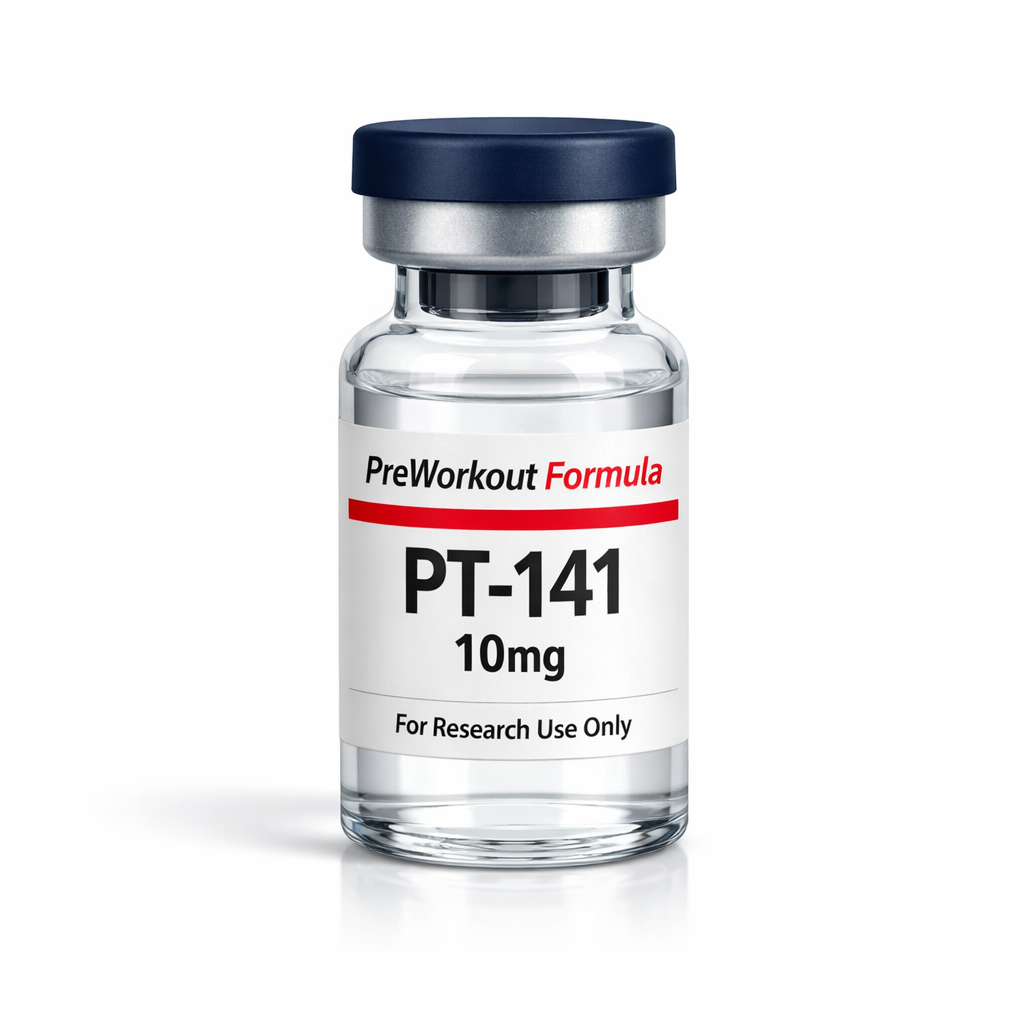
PT-141
$44.99
PT-141 (Bremelanotide) — research-grade melanocortin receptor agonist. 99%+ purity, HPLC verified. 10mg lyophilized powder per vial.
Description
PT-141 (Bremelanotide) — Research Profile
Palatin Technologies filed the original IND for bremelanotide in 2004 after a clinical observation that nobody expected. During Phase II trials of Melanotan II for tanning, male subjects reported spontaneous erections unrelated to visual or tactile stimulation. The responsible metabolite was isolated, modified into a cyclic heptapeptide, and designated PT-141 — the first melanocortin receptor agonist shown to activate sexual arousal pathways through central nervous system mechanisms rather than peripheral vasodilation.
That distinction matters. Every prior pharmacological approach to sexual function targeted blood flow. PT-141 targets the brain.
Mechanism and Receptor Pharmacology
PT-141 is a non-selective melanocortin receptor agonist with highest affinity for MC3R and MC4R subtypes. Research published in the Journal of Sexual Medicine (2008) established that its pro-sexual effects are mediated primarily through MC4R activation in the hypothalamus — specifically the paraventricular nucleus (PVN) and medial preoptic area (MPOA), both regions critically involved in sexual motivation circuitry.
MC4R activation in these regions triggers downstream dopaminergic and oxytocinergic signaling. This isn’t a reflex arc or a vascular event. It’s activation of the same motivational neural networks that process natural sexual arousal cues. Pfaus and colleagues demonstrated this in Neuroscience & Biobehavioral Reviews (2004), showing PT-141 increased solicitation behaviors in female rat models — a specific marker of central sexual motivation distinct from receptivity.
The peptide also exhibits activity at MC1R (melanogenesis) and MC3R (energy homeostasis), though these are considered secondary to its MC4R-mediated research applications.
Clinical Development History
PT-141’s research trajectory is unusually well-documented for a peptide compound:
- Phase II trials (2003-2004): Intranasal formulation showed efficacy in erectile dysfunction patients who had failed PDE5 inhibitors — a population with no other pharmacological options at the time
- FDA clinical hold (2007): Intranasal formulation shelved due to blood pressure elevation concerns at higher doses
- Reformulation as subcutaneous injection: Eliminated the dose-dependent blood pressure issue seen with intranasal rapid absorption
- Phase III (RECONNECT trials, 2016-2018): Subcutaneous bremelanotide for hypoactive sexual desire disorder (HSDD) in premenopausal women
- FDA approval (June 2019): Vyleesi (bremelanotide) approved for HSDD — making it the first melanocortin-based drug approved for any indication
Primary Research Areas
- Central melanocortin pathway mapping — MC3R/MC4R signaling in hypothalamic nuclei
- Sexual motivation versus arousal distinction in behavioral models
- Dopamine-oxytocin interaction in PVN sexual circuits
- Melanocortin receptor cross-talk between sexual, metabolic, and inflammatory pathways
- Rescue pharmacology in PDE5-inhibitor-refractory models
- Female sexual desire neurobiology — MPOA and ventromedial hypothalamus circuits
Specifications
| Sequence | Ac-Nle-cyclo[Asp-His-D-Phe-Arg-Trp-Lys]-OH |
| Molecular Weight | 1025.18 g/mol |
| CAS Number | 189691-06-3 |
| Purity | ≥99% (HPLC verified) |
| Form | Lyophilized powder |
| Quantity | 10mg per vial |
| Storage | -20°C pre-reconstitution, 2-8°C post-reconstitution |
Published Dosing in Research Literature
The FDA-approved dose for Vyleesi is 1.75mg subcutaneous, administered 45 minutes before anticipated activity, with a maximum of one dose per 24 hours and no more than 8 doses per month. Phase II erectile dysfunction trials used intranasal doses of 7-20mg (different bioavailability profile than subcutaneous). Animal behavioral studies have used 0.5-2mg/kg IP in rodent models.
A 10mg vial reconstituted in 2mL bacteriostatic water yields 5mg/mL. Peak plasma concentration occurs approximately 1 hour post-subcutaneous administration. Terminal half-life is approximately 2.7 hours.
Frequently Asked Questions
How does PT-141 differ mechanistically from PDE5 inhibitors like sildenafil?
Completely different targets. PDE5 inhibitors work peripherally — they prevent breakdown of cGMP in penile vascular smooth muscle, enhancing blood flow in response to existing nitric oxide signaling. They require sexual arousal to already be present; they just improve the vascular response. PT-141 works centrally in the hypothalamus via MC4R activation, generating the motivational and arousal signals upstream of any vascular event. This is why PT-141 showed efficacy in clinical subjects who failed sildenafil — the problem in those patients wasn’t vascular, it was central signaling.
Why was the intranasal formulation abandoned?
Dose-dependent transient increases in blood pressure observed during Phase II intranasal trials triggered an FDA clinical hold in 2007. The intranasal route delivers peptide rapidly into systemic circulation through the nasal mucosa, producing higher peak plasma concentrations than subcutaneous injection. The blood pressure effect correlated with Cmax rather than AUC — meaning it was the spike, not the total exposure, causing the issue. Switching to subcutaneous administration produced a slower absorption curve with lower Cmax, and the blood pressure signal largely disappeared. The RECONNECT Phase III trials with subcutaneous dosing showed clinically insignificant blood pressure changes.
What is the relationship between PT-141 and Melanotan II?
PT-141 is a metabolite-derived analog of Melanotan II. Both are synthetic analogs of alpha-MSH (alpha-melanocyte-stimulating hormone) and both activate melanocortin receptors. Melanotan II is a broader agonist — it hits MC1R (tanning), MC3R, MC4R, and MC5R with varying affinity. PT-141 was specifically developed from the structural elements of Melanotan II responsible for MC4R activation in sexual arousal pathways, while reducing (but not eliminating) MC1R activity. Think of it as a pharmacological refinement: same receptor family, more targeted binding profile.
Does PT-141 affect female sexual function differently than male?
The neural circuits are partially overlapping but distinct. In males, MC4R activation in the PVN triggers oxytocinergic pathways to spinal erectile centers — a relatively direct descending pathway. In females, the circuit involves broader hypothalamic networks including the ventromedial hypothalamus and MPOA, modulating sexual motivation, receptivity, and desire as separable behavioral components. Pfaus et al. (2004) showed PT-141 specifically increased proceptive (solicitation) behaviors in female rodent models without affecting receptivity — meaning it enhanced desire/motivation independently of physical arousal readiness. The FDA ultimately approved bremelanotide for female HSDD specifically, recognizing this desire-specific mechanism.
What are the documented side effects from clinical trial data?
The RECONNECT Phase III data (published in Obstetrics & Gynecology, 2019) documented nausea as the most common adverse event — approximately 40% of subjects in the treatment arm. Nausea was typically transient (resolving within 2 hours), decreased with repeated dosing, and was the primary reason for the 8-dose-per-month limitation in the approved labeling. Other reported effects: flushing (20%), headache (11%), and injection site reactions (5%). The transient blood pressure elevation was minimal with subcutaneous dosing — mean increase of 2-3 mmHg systolic.
Can PT-141 cause permanent skin darkening?
PT-141 retains some MC1R activity (the melanogenesis receptor), but significantly less than Melanotan II. In clinical trials at the approved 1.75mg subcutaneous dose, focal hyperpigmentation was reported in approximately 1% of subjects — typically small areas around the face, gingiva, or breasts. These changes were described as mild, reversible upon discontinuation, and not dose-limiting. At higher research doses or with repeated chronic administration, MC1R activation could theoretically produce more noticeable melanogenesis, though this hasn’t been systematically studied at supratherapeutic doses in humans.
Related Research Peptides
For melanocortin pathway research, see Melanotan II (broader MC receptor agonist) or Kisspeptin (GnRH pulse generator modulation). Researchers studying neuropeptide signaling may also explore DSIP (neuroendocrine modulation) or AOD-9604 (GH fragment research). Full catalog at peptides for sale.
For research and laboratory use only. Not for human consumption. All peptides are sold strictly as research chemicals.