Kisspeptin
$54.99
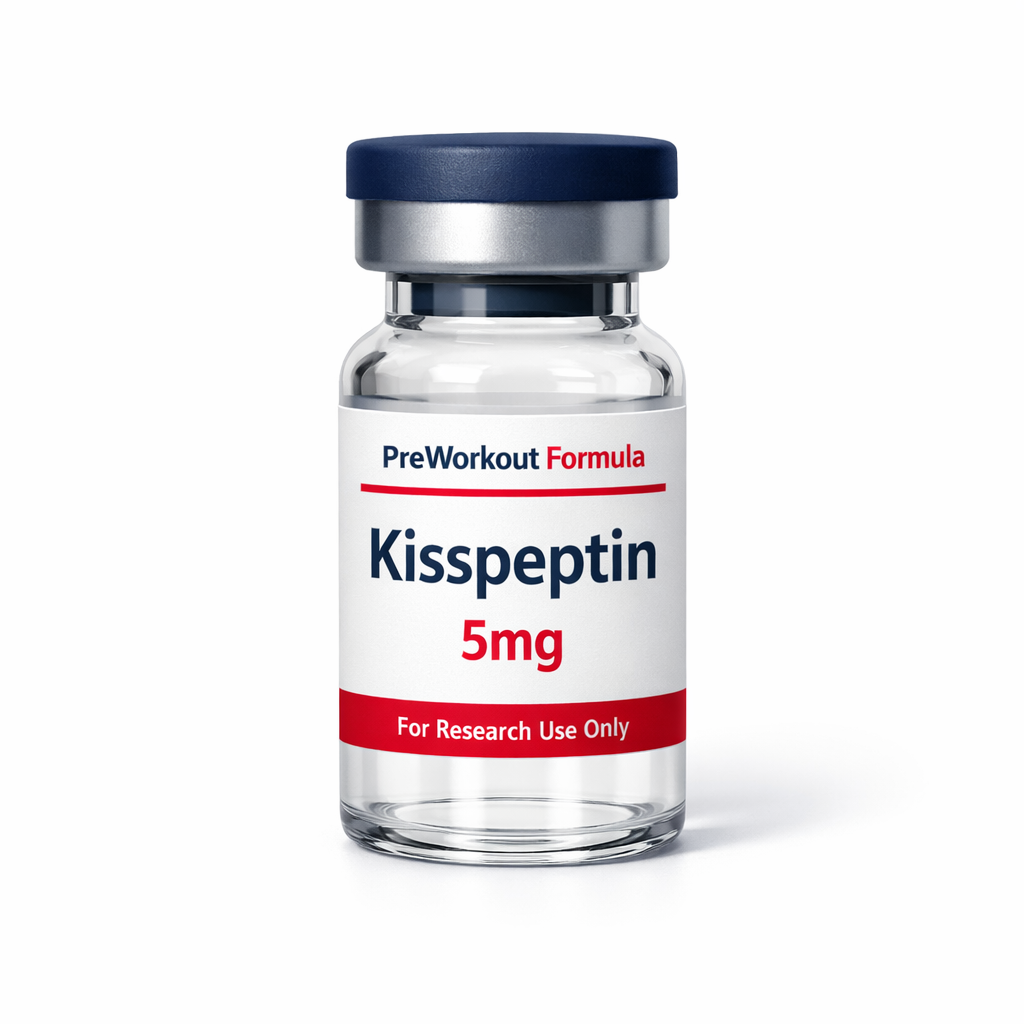
Kisspeptin-10 — research-grade GnRH axis peptide. 99%+ purity, HPLC verified. 5mg lyophilized powder per vial.
Description
Kisspeptin — Research Profile
In 1996, researchers at Penn State University identified a tumor suppression gene at chromosome 1q32 and named it KISS1 — after Hershey’s Kisses, because the lab was located in Hershey, Pennsylvania. Six years later, three independent research groups simultaneously discovered that mutations in the KISS1 receptor (GPR54) caused idiopathic hypogonadotropic hypogonadism in humans. Overnight, a gene named after chocolate became the master regulator of reproductive endocrinology.
Kisspeptin — the peptide product of the KISS1 gene — is now recognized as the most potent known stimulator of GnRH (gonadotropin-releasing hormone) secretion. A single bolus injection triggers an LH pulse within minutes. No other known endogenous signal drives GnRH neurons with comparable potency or reliability.
Mechanism and Neuroendocrine Signaling
Kisspeptin binds KISS1R (formerly GPR54), a G-protein-coupled receptor expressed on GnRH neurons in the hypothalamus. Binding activates Gq/11 signaling, which depolarizes GnRH neurons through PLC-mediated calcium release and PKC activation. The result: pulsatile GnRH release into the hypophyseal portal system, triggering anterior pituitary secretion of LH and FSH.
Research published in the Journal of Clinical Investigation (2005) by Dhillo and colleagues provided the first human proof-of-concept — IV kisspeptin-54 administration to healthy male volunteers produced a rapid, dose-dependent increase in circulating LH, FSH, and testosterone. The LH response was striking: 5-fold increases within 30 minutes at higher doses.
Two anatomically distinct kisspeptin neuron populations drive this system. The arcuate nucleus (ARC) population co-expresses neurokinin B and dynorphin — forming the “KNDy” neurons that generate pulsatile GnRH release. The anteroventral periventricular nucleus (AVPV) population mediates the preovulatory LH surge in females. Same peptide, different locations, different reproductive functions. Published in Endocrine Reviews (2012) by Oakley et al.
Primary Research Areas
- GnRH pulse generator physiology — KNDy neuron network dynamics
- Puberty onset mechanisms — kisspeptin expression timing and triggers
- Hypothalamic amenorrhea and functional gonadotropin deficiency models
- Preovulatory LH surge induction — potential IVF trigger applications (Jayasena et al., Journal of Clinical Endocrinology & Metabolism, 2014)
- Sex steroid feedback integration — estrogen/testosterone modulation of KISS1 expression
- Metabolic-reproductive crosstalk — leptin signaling through kisspeptin neurons
- Tumor metastasis suppression — the original KISS1 gene function
Specifications
| Form | Kisspeptin-10 (C-terminal decapeptide, full receptor activity) |
| Molecular Weight | 1302.44 g/mol |
| CAS Number | 374675-21-5 |
| Purity | ≥99% (HPLC verified) |
| Form | Lyophilized powder |
| Quantity | 5mg per vial |
| Storage | -20°C pre-reconstitution, 2-8°C post-reconstitution |
Published Dosing in Research Literature
Human research protocols have used several kisspeptin forms. Dhillo’s landmark 2005 study used kisspeptin-54 at 0.12-0.6 nmol/kg IV. Subsequent work by the same Imperial College London group used kisspeptin-54 at 1.5 nmol/kg subcutaneous for IVF trigger studies. Kisspeptin-10 (the form supplied here) retains full KISS1R binding affinity but has a shorter half-life — approximately 4 minutes IV versus 28 minutes for kisspeptin-54. Animal studies typically use 1-10 nmol ICV or 50-100 nmol IP in rodent models.
A 5mg vial reconstituted in 1mL bacteriostatic water yields 5mg/mL. The short half-life of kisspeptin-10 means timing and route of administration significantly impact downstream hormonal response magnitude.
Frequently Asked Questions
What is the difference between kisspeptin-10 and kisspeptin-54?
Kisspeptin-54 is the full-length peptide product of KISS1 gene processing — 54 amino acids. Kisspeptin-10 is the C-terminal decapeptide fragment (residues 45-54) that contains the complete receptor-binding domain. Both bind KISS1R with comparable affinity and produce identical downstream signaling. The practical difference is pharmacokinetic: kisspeptin-54 has a longer circulating half-life (~28 minutes) due to reduced susceptibility to matrix metalloproteinase degradation compared to kisspeptin-10 (~4 minutes). For acute stimulation studies, both work. For sustained GnRH drive, kisspeptin-54 may be preferred due to extended receptor occupancy time.
Why is kisspeptin considered the “master switch” of reproduction?
Because without functional kisspeptin signaling, puberty does not occur and reproductive function ceases. Human loss-of-function mutations in KISS1R cause complete idiopathic hypogonadotropic hypogonadism — reported simultaneously by de Roux et al. (PNAS, 2003) and Seminara et al. (NEJM, 2003). GnRH neurons are present and functional in these patients; they simply never receive the activation signal. Conversely, gain-of-function KISS1R mutations cause precocious puberty (Teles et al., NEJM, 2008). No other single signaling pathway has been shown to be both necessary and sufficient for GnRH neuron activation at the population level.
How does kisspeptin relate to metabolic status and body composition?
Kisspeptin neurons in the arcuate nucleus express leptin receptors. This positions them as direct integrators of metabolic status into reproductive signaling. When energy availability drops — caloric restriction, excessive exercise, low body fat — leptin levels fall, kisspeptin expression decreases, GnRH pulsatility declines, and the reproductive axis shuts down. This is the molecular mechanism behind hypothalamic amenorrhea in underweight or energy-deficient individuals. Research by Castellano et al. (Endocrinology, 2005) demonstrated that kisspeptin administration could rescue gonadotropin secretion in food-restricted animal models, effectively overriding the metabolic stop signal.
Can kisspeptin replace hCG as an IVF trigger?
This is an active clinical research area. Jayasena and colleagues at Imperial College London published Phase II data (JCEM, 2014) showing subcutaneous kisspeptin-54 triggered oocyte maturation in IVF patients. The advantage over hCG: kisspeptin produces a more physiological LH surge (shorter duration, more closely mimicking natural preovulatory signaling) and appears to carry significantly lower risk of ovarian hyperstimulation syndrome (OHSS) — a serious and sometimes dangerous complication of standard IVF protocols. Multiple clinical trials are ongoing evaluating kisspeptin as an OHSS-free trigger alternative.
Does kisspeptin affect testosterone in males?
Potently. Dhillo’s 2005 human study showed IV kisspeptin-54 increased circulating testosterone in healthy men through the expected LH-mediated pathway. George et al. (JCEM, 2011) further demonstrated that kisspeptin restored LH pulsatility and testosterone levels in men with experimentally suppressed gonadotropins. The response is rapid — testosterone increases detectable within 30-60 minutes — and dose-dependent. However, continuous kisspeptin infusion (as opposed to pulsatile) causes KISS1R desensitization and paradoxical GnRH suppression within hours, which is important for research protocol design.
What is receptor desensitization and why does it matter for kisspeptin research?
Continuous kisspeptin exposure causes KISS1R internalization and desensitization — the receptor is pulled from the cell surface and GnRH neurons become refractory. Seminara’s group showed that continuous kisspeptin infusion initially stimulates robust LH secretion, but LH levels decline to baseline within 6-12 hours despite ongoing kisspeptin exposure. This tachyphylaxis is consistent with GPCR pharmacology but has significant implications: it means kisspeptin must be administered in a pulsatile pattern (mimicking endogenous KNDy neuron firing) to sustain gonadotropin stimulation. Continuous infusion actually becomes functionally suppressive — a potential research application in its own right for reversible gonadal suppression.
What was the original cancer metastasis connection?
KISS1 was first identified as a metastasis suppressor gene in melanoma cell lines — its expression inversely correlated with metastatic potential. The name literally comes from the Hershey, PA lab where it was discovered. Subsequent research confirmed KISS1/kisspeptin suppresses metastasis in breast, ovarian, and thyroid cancer models without affecting primary tumor growth. The mechanism involves kisspeptin-KISS1R signaling inhibiting matrix metalloproteinase expression and reducing cancer cell motility and invasion capacity. This original function is largely separate from the reproductive neuroendocrinology that dominates current kisspeptin research.
Related Research Peptides
For reproductive axis research, see PT-141 (melanocortin pathway, hypothalamic sexual signaling) and Melanotan II (MC4R agonist). For neuroendocrine modulation, explore DSIP (HPA axis) or AOD-9604 (GH axis fragment). Full catalog at peptides for sale.
For research and laboratory use only. Not for human consumption. All peptides are sold strictly as research chemicals.