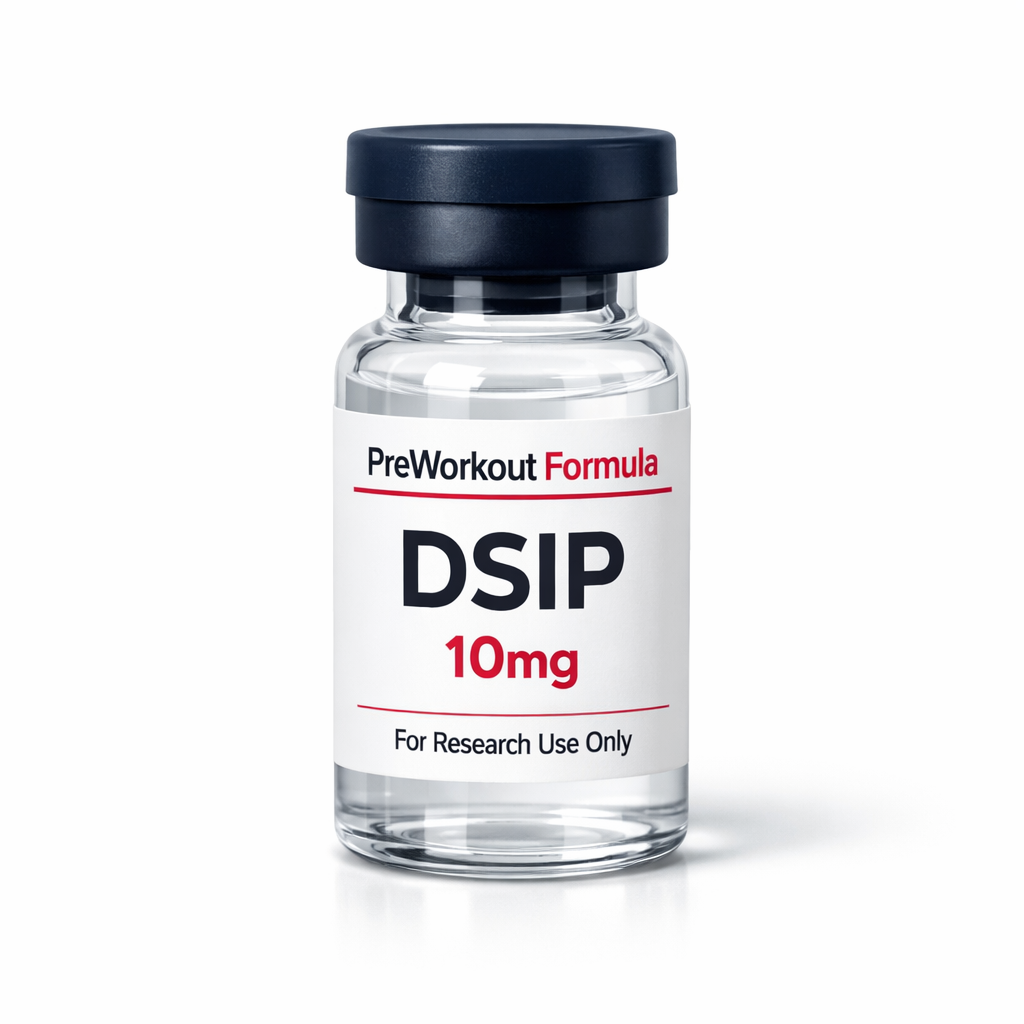
DSIP
$49.00
DSIP (Delta Sleep-Inducing Peptide) — research-grade nonapeptide. 99%+ purity, HPLC verified. 5mg lyophilized powder per vial.
Description
DSIP (Delta Sleep-Inducing Peptide) — Research Profile
A 1977 paper in the Proceedings of the National Academy of Sciences first isolated a nonapeptide from rabbit brain venous blood during slow-wave sleep. That nine-amino-acid chain — Trp-Ala-Gly-Gly-Asp-Ala-Ser-Gly-Glu — became known as Delta Sleep-Inducing Peptide (DSIP). Nearly five decades of research later, DSIP remains one of the more pharmacologically puzzling neuropeptides on record. No receptor has been definitively identified. No single mechanism of action fully explains its effects. Yet published data across dozens of studies consistently demonstrates measurable modulation of sleep architecture, stress response, and neuroendocrine signaling.
That paradox — robust observable effects without a clean receptor-binding model — is exactly what makes DSIP a compelling research compound.
Mechanism and Pharmacology
DSIP crosses the blood-brain barrier via a saturable transport mechanism documented in Peptides (2003). Once centrally available, it modulates multiple neurotransmitter systems simultaneously. Published findings in the European Journal of Pharmacology (1989) show DSIP influences GABAergic, glutamatergic, and serotonergic signaling — not through direct receptor agonism, but through what appears to be modulatory activity on existing neural oscillation patterns.
The peptide also demonstrates significant effects on the hypothalamic-pituitary-adrenal (HPA) axis. Research from Neuroendocrinology Letters (2001) documented DSIP’s ability to normalize disrupted ACTH and cortisol rhythms in stress models. This isn’t simple sedation. The compound appears to recalibrate circadian neuroendocrine signaling rather than suppress wakefulness.
Half-life is short — roughly 7-8 minutes in plasma. But behavioral and EEG effects persist far longer than plasma clearance would predict, suggesting tissue-level accumulation or downstream cascade activation that outlasts the parent molecule.
Primary Research Areas
- Sleep architecture modulation — delta wave (Stage 3/4 NREM) enhancement without REM suppression
- HPA axis normalization under chronic stress conditions
- Opioid and alcohol withdrawal symptom attenuation (Larbig et al., Pain, 1984)
- Antioxidant enzyme upregulation — SOD and catalase induction documented in Regulatory Peptides (2006)
- Circadian rhythm resynchronization models
- Neuroprotective effects in oxidative stress paradigms
Specifications
| Sequence | Trp-Ala-Gly-Gly-Asp-Ala-Ser-Gly-Glu |
| Molecular Weight | 848.81 g/mol |
| CAS Number | 62568-57-4 |
| Purity | ≥99% (HPLC verified) |
| Form | Lyophilized powder |
| Quantity | 5mg per vial |
| Storage | -20°C pre-reconstitution, 2-8°C post-reconstitution |
Published Dosing in Research Literature
Human clinical studies — yes, actual human data exists for DSIP — used doses ranging from 25-30 nmol/kg IV in the original Schneider-Helmert sleep studies (Psychopharmacology, 1981). Subsequent chronic insomnia research by the same group used nightly IV administration for 5-6 consecutive nights, observing normalized sleep patterns that persisted after discontinuation. Animal studies have used broader dose ranges: 10-100mcg/kg in rodent stress and sleep models.
A 5mg vial reconstituted in 1mL bacteriostatic water yields 5mg/mL (5,000mcg/mL). The short plasma half-life means timing of administration relative to measurement endpoints is critical in study design.
Frequently Asked Questions
Why hasn’t a specific receptor for DSIP been identified after decades of research?
DSIP appears to function as a neuromodulator rather than a classical receptor agonist. Instead of binding a single dedicated receptor and triggering one signaling cascade, evidence suggests DSIP modulates the activity of multiple existing neurotransmitter systems — GABAergic, glutamatergic, serotonergic — simultaneously. Some researchers have proposed it acts at the level of membrane fluidity or ion channel gating rather than through a protein receptor. A 2008 review in the Journal of Neurochemistry noted that this multimodal mechanism may be precisely why the compound produces broad physiological effects that resist classification under a single receptor model.
Does DSIP actually induce sleep, or does it modify sleep quality?
The name is somewhat misleading. Schneider-Helmert’s human studies (1981, 1987) showed DSIP doesn’t act as a sedative or hypnotic. Subjects didn’t fall asleep faster or sleep longer in a simple dose-response pattern. What changed was sleep architecture — specifically, increased time in slow-wave (delta) sleep stages without suppressing REM. In chronic insomnia patients, the effect was more pronounced: normalization of disrupted sleep patterns that persisted 1-2 weeks after the final dose. This sustained post-treatment effect is unusual and distinguishes DSIP from classical sleep medications.
What is the relationship between DSIP and the stress response?
DSIP modulates the HPA axis at multiple levels. Research in Annals of the New York Academy of Sciences (1993) documented that DSIP administration normalized ACTH pulsatility patterns in chronically stressed animal models — essentially restoring the natural ultradian rhythm rather than suppressing cortisol output. Separate work showed DSIP reduced stress-induced changes in monoamine metabolism in brain tissue. The compound doesn’t block the stress response. It appears to restore regulatory set-points that chronic stress disrupts.
Can DSIP survive enzymatic degradation given its short half-life?
Plasma half-life is approximately 7-8 minutes due to rapid aminopeptidase degradation. However, DSIP exists in blood in both free and bound forms. The bound fraction — associated with carrier proteins — is protected from enzymatic degradation and may serve as a reservoir for sustained release. Research published in Peptides (1994) identified that roughly 40-60% of circulating DSIP is protein-bound at any given time. This dual-pool pharmacokinetic model may explain why behavioral effects persist hours after plasma free-DSIP becomes undetectable.
What makes DSIP different from melatonin in sleep research?
Different targets entirely. Melatonin acts on MT1/MT2 receptors as a circadian timing signal — it tells the brain “it’s nighttime” but doesn’t directly modify sleep stage architecture. DSIP modulates the actual electrophysiology of sleep — specifically enhancing slow-wave delta activity during NREM stages. Melatonin primarily affects sleep onset latency and circadian phase-shifting. DSIP primarily affects sleep depth and architecture quality. In research settings, they address fundamentally different questions about sleep regulation.
Has DSIP been studied for pain modulation?
Yes. Larbig and colleagues published pain research with DSIP in Pain (1984), demonstrating analgesic effects in chronic pain patients. The mechanism appears to involve modulation of endogenous opioid systems — DSIP has been shown to influence met-enkephalin and beta-endorphin levels in brain tissue. Separate research documented DSIP’s effects on reducing opiate withdrawal symptoms in addicted subjects, published in the European Journal of Clinical Pharmacology (1984). These aren’t direct opioid receptor effects but rather modulatory interactions with endogenous pain and reward circuitry.
What is DSIP’s role in oxidative stress research?
Bondarenko (2006) in Regulatory Peptides demonstrated that DSIP administration upregulates superoxide dismutase (SOD) and catalase — two primary endogenous antioxidant enzymes — in brain tissue. This wasn’t a minor effect: enzyme activity increases were statistically significant and dose-dependent. The mechanism may involve DSIP’s interaction with nuclear transcription factors regulating antioxidant gene expression. This antioxidant capacity adds a neuroprotective dimension to DSIP research beyond its sleep and stress applications, particularly relevant for neurodegeneration and ischemia-reperfusion models.
Is DSIP found naturally in the human body?
Yes. DSIP is an endogenous neuropeptide present in human plasma and cerebrospinal fluid. Circulating levels follow a diurnal pattern — higher during nighttime hours, lower during the day — which was documented in early immunoassay studies. The peptide has been detected in multiple brain regions including the hypothalamus, limbic structures, and pituitary. Its endogenous concentrations are in the picomolar range, consistent with a role as a neuromodulatory signal rather than a bulk neurotransmitter.
Related Research Peptides
Researchers investigating sleep and neuroendocrine signaling may also explore PT-141 (hypothalamic melanocortin pathway), Kisspeptin (GnRH axis modulation), or Melanotan II (central melanocortin receptor agonist). Browse our full peptide catalog for additional compounds.
For research and laboratory use only. Not for human consumption. All peptides are sold strictly as research chemicals.