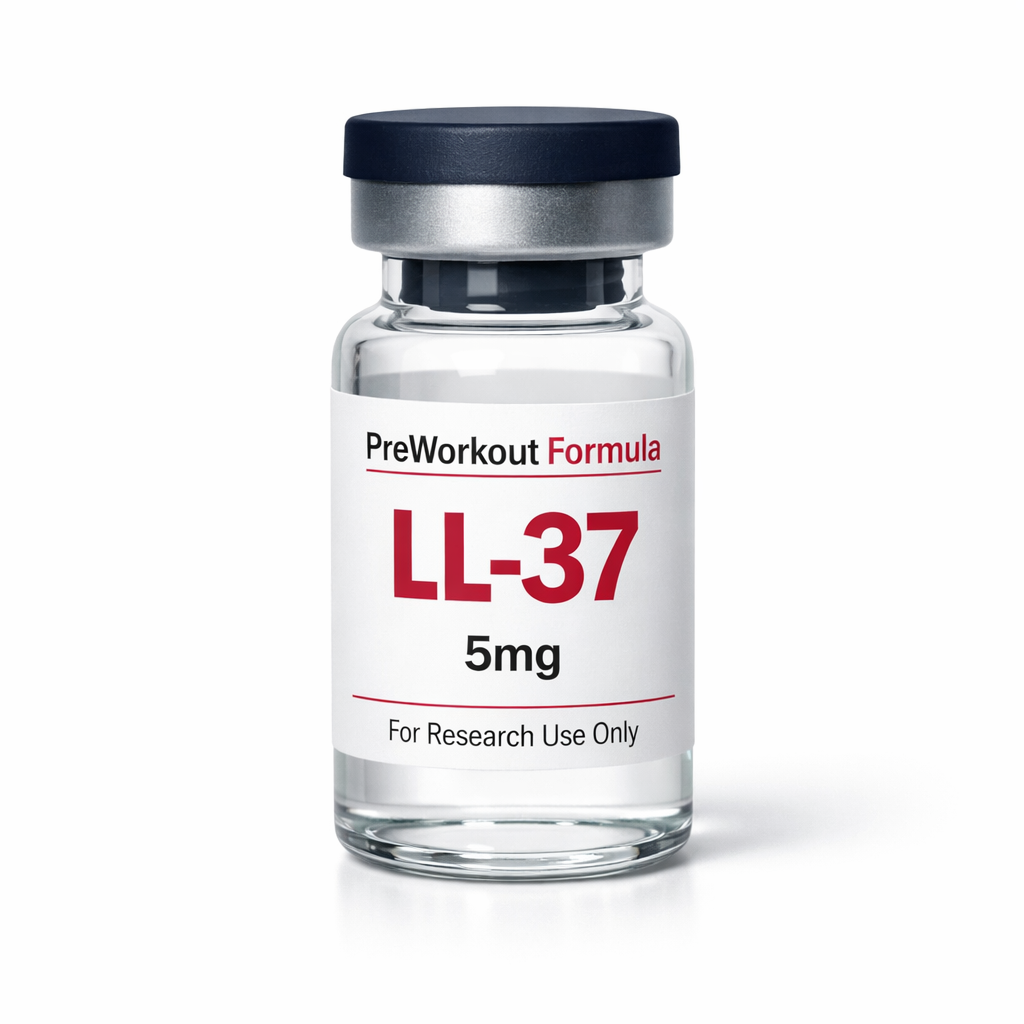
LL-37
$54.99
Human cathelicidin antimicrobial peptide (37 amino acids). 5mg lyophilized powder, ≥99% HPLC-verified purity. Studied for broad-spectrum antimicrobial activity, biofilm disruption, wound healing, and immune modulation. COA included.
Description
LL-37: Human Cathelicidin — The Endogenous Antimicrobial Peptide
37 amino acids starting with two leucine residues — that’s where the name comes from. LL-37 is the only cathelicidin-derived antimicrobial peptide produced in the human body, cleaved from its precursor protein hCAP-18 by proteinase 3 in neutrophil granules. First fully characterized by Gudmundsson et al. in European Journal of Biochemistry (1996), this peptide sits at the intersection of innate immunity and tissue repair research in ways that few other compounds can match.
Circulating concentrations tell an interesting story. Healthy human plasma contains approximately 1.2 μg/mL of LL-37. At wound sites, local concentrations spike to 20+ μg/mL within hours — a 15-fold increase driven by neutrophil degranulation and epithelial cell upregulation. That concentration gradient is one of the primary research observations driving current investigation into LL-37’s role beyond simple antimicrobial activity.
Peptide Specifications
| Parameter | Detail |
|---|---|
| Sequence | LLGDFFRKSKEKIGKEFKRIVQRIKDFLRNLVPRTES |
| Molecular Weight | 4493.33 g/mol |
| Purity | ≥99% (HPLC verified) |
| Form | Lyophilized powder |
| Quantity | 5mg per vial |
| Storage | -20°C prior to reconstitution |
| CAS Number | 154947-66-7 |
Research Applications by Evidence Strength
Broad-Spectrum Antimicrobial Activity: LL-37’s amphipathic alpha-helical structure allows it to disrupt microbial membranes directly. Turner et al. (Antimicrobial Agents and Chemotherapy, 1998) documented bactericidal activity against gram-positive organisms (S. aureus, including MRSA strains), gram-negative bacteria (E. coli, P. aeruginosa), and select fungal species. The mechanism — membrane disruption rather than metabolic targeting — makes resistance development significantly less likely than with conventional antibiotics.
Biofilm Disruption: Possibly LL-37’s most clinically relevant research area. Overhage et al. published in Infection and Immunity (2008) that sub-inhibitory concentrations of LL-37 prevented P. aeruginosa biofilm formation and disrupted established biofilms. The peptide affected twitching motility, quorum sensing gene expression, and initial surface attachment — hitting biofilm development at multiple stages simultaneously.
Wound Healing Modulation: Beyond killing pathogens, LL-37 actively participates in tissue repair. Heilborn et al. (Journal of Investigative Dermatology, 2003) found LL-37 deficiency in chronic wound fluid compared to acute wounds — suggesting the peptide plays a functional role in healing progression. Mechanistically, LL-37 promotes keratinocyte migration through EGFR transactivation and stimulates angiogenesis via FPRL1 receptor signaling.
Immune Cell Recruitment: LL-37 acts as a chemoattractant for neutrophils, monocytes, and T-cells through formyl peptide receptor-like 1 (FPRL1) activation. De Yang et al. (Journal of Experimental Medicine, 2000) characterized this chemotactic activity as a bridge between innate and adaptive immunity — the peptide doesn’t just kill pathogens, it recruits the full immune response to the site.
Structural Properties Relevant to Research Design
LL-37 adopts an alpha-helical conformation in membrane-mimicking environments but remains unstructured in aqueous solution. This conformational switching is functionally critical — the helix forms upon contact with bacterial membranes, inserting hydrophobic residues into the lipid bilayer. Researchers working with LL-37 should note that circular dichroism measurements will vary dramatically depending on the solvent system used.
The peptide carries a net charge of +6 at physiological pH. This cationic character drives electrostatic attraction to negatively charged bacterial membranes while showing lower affinity for the more neutrally charged mammalian cell surfaces — a selectivity mechanism that defines its antimicrobial specificity.
Reconstitution & Storage
Reconstitute in sterile water or bacteriostatic water at 1-2mL per 5mg vial. LL-37 is susceptible to adsorption onto plastic surfaces — use low-binding polypropylene tubes for storage and handling. Reconstituted solution: 2-8°C, use within 14 days. For longer storage, aliquot into single-use volumes to avoid repeated freeze-thaw degradation.
Frequently Asked Questions
What makes LL-37 unique among antimicrobial peptides?
LL-37 is the sole cathelicidin-derived antimicrobial peptide in humans. While other species produce multiple cathelicidins, humans have only one — making LL-37 singularly important to human innate immunity research. Its dual role as both antimicrobial agent and immune modulator distinguishes it from purely bactericidal compounds.
How does LL-37 kill bacteria differently from antibiotics?
Conventional antibiotics target specific metabolic pathways (cell wall synthesis, protein production, DNA replication). LL-37 physically disrupts bacterial cell membranes through electrostatic interaction and insertion. This membrane-lytic mechanism is far more difficult for bacteria to develop resistance against — they’d need to fundamentally alter their membrane composition.
Why is LL-37 relevant to biofilm research?
Biofilms are responsible for approximately 80% of chronic bacterial infections and are notoriously resistant to conventional antibiotics. LL-37 attacks biofilm formation at multiple stages — preventing initial attachment, disrupting quorum sensing communication, and breaking down established biofilm matrices. Published data shows efficacy at sub-MIC concentrations.
What is the connection between LL-37 and vitamin D?
Vitamin D3 directly upregulates hCAP-18/LL-37 gene expression. Liu et al. (Science, 2006) demonstrated that TLR activation in macrophages triggers vitamin D-dependent LL-37 production — a finding that linked vitamin D status to innate antimicrobial defense. This vitamin D-LL-37 axis is now a major focus in immunology research.
Can LL-37 be studied alongside other peptides?
Yes. Common research pairings include BPC-157 (for wound healing studies where antimicrobial and tissue repair factors are both relevant) and KPV (for immune modulation protocols). LL-37’s membrane-disruption mechanism doesn’t interfere with the intracellular pathways these peptides target.
Why does the storage protocol mention low-binding tubes?
LL-37’s amphipathic structure causes it to adsorb onto standard polystyrene and polypropylene surfaces, reducing effective concentration in solution. Low-binding tubes have surface treatments that minimize this adsorption. Without them, researchers may see up to 30% peptide loss to container walls — a significant variable in dosing studies.
What concentration range is used in antimicrobial assays?
Published MIC (minimum inhibitory concentration) values range from 2-32 μg/mL depending on the organism. Biofilm disruption studies typically use sub-MIC concentrations (0.5-2 μg/mL). In vivo wound models use higher concentrations reflecting the 20+ μg/mL levels observed naturally at injury sites.
Is LL-37 effective against antibiotic-resistant bacteria?
Published data confirms activity against MRSA (methicillin-resistant S. aureus), VRE (vancomycin-resistant enterococci), and multi-drug-resistant P. aeruginosa strains. The membrane-disruption mechanism is independent of the metabolic pathways these organisms have developed resistance to.
Related Products
- BPC-157 — Tissue repair peptide commonly studied alongside LL-37 in wound models
- KPV — Anti-inflammatory tripeptide with complementary immune modulation research
- Thymosin Alpha 1 — Immune-activating peptide studied for innate defense enhancement
- GHK-Cu — Copper peptide with overlapping wound healing research applications
This product is intended for laboratory and research use only. Not for human consumption. All buyers must be qualified researchers or institutions. By purchasing, you agree to use this product solely for legitimate research purposes.