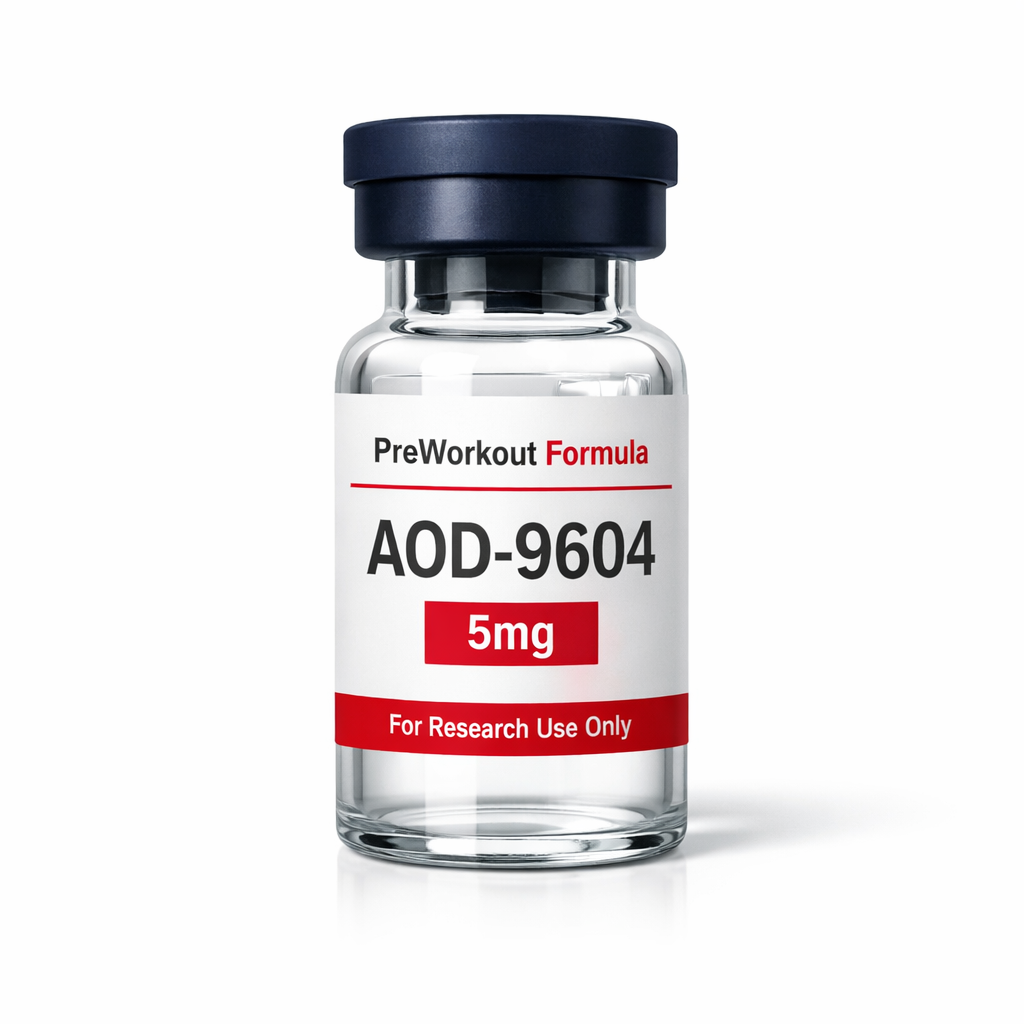
AOD-9604
$44.99
AOD-9604 (hGH Fragment 176-191) — research-grade modified GH fragment. 99%+ purity, HPLC verified. 5mg lyophilized powder per vial.
Description
AOD-9604 — Research Profile
Between 1995 and 2007, Metabolic Pharmaceuticals spent over $50 million developing a single peptide fragment through Phase III clinical trials for obesity. AOD-9604 — the C-terminal 16-amino-acid fragment of human growth hormone (residues 176-191) with a stabilizing tyrosine at position 177 — made it further through FDA-track clinical development than almost any other research peptide in this class. The Phase III trial ultimately failed to meet its primary efficacy endpoint for weight loss. But the safety data from over 900 human subjects across multiple trials is arguably the most valuable legacy of that program.
That’s a rare dataset for a research peptide. Most compounds in this space have animal data and maybe a Phase I. AOD-9604 has Phase I through Phase III human PK, safety, and tolerability data — plus FDA GRAS status granted in 2014.
Mechanism of Action
Full-length human growth hormone (hGH) is a 191-amino-acid protein with multiple functional domains. The N-terminal region drives GH receptor binding, IGF-1 production, and growth-promoting effects. The C-terminal region — specifically residues 176-191 — drives lipolytic activity through a mechanism that does not require GH receptor activation.
Professor Frank Ng’s laboratory at Monash University first isolated this fragment and demonstrated its independent lipolytic capacity in Endocrinology (1994). The mechanism involves beta-3 adrenergic receptor stimulation on adipocytes, triggering hormone-sensitive lipase activation and fatty acid release. Critically, this pathway operates independently of the GH receptor — meaning AOD-9604 doesn’t affect IGF-1 levels, hepatic glucose output, or insulin sensitivity. Research published in the Journal of Endocrinology (2000) confirmed no GH receptor competition in binding assays.
AOD-9604 also inhibits lipogenesis (new fat formation) in adipocyte models. Ng’s group showed this dual action — stimulating fat breakdown while simultaneously inhibiting fat synthesis — in differentiated 3T3-L1 adipocyte cultures, published in Obesity Research (2000).
Clinical Trial Data Summary
Few research peptides have this depth of human clinical data:
- Phase I (Monash University): Single and multiple ascending dose studies in healthy volunteers. Established safety and PK at doses from 1-54mg. No serious adverse events. No effects on IGF-1, glucose, or insulin
- Phase IIa: 300 obese subjects, 12 weeks, multiple dose groups (1mg, 5mg, 10mg, 20mg, 30mg SC daily). Statistically significant weight loss versus placebo at mid-range doses. Published safety profile remained clean
- Phase IIb: Larger cohort, confirmed dose-response. Mid-range doses (10-20mg) showed optimal efficacy-to-safety ratio
- Phase III: ~500 subjects, 24 weeks, failed to reach primary endpoint (statistically significant weight loss vs placebo at 24 weeks). The magnitude of weight loss, while present, was modest and didn’t meet regulatory thresholds. Program discontinued 2007
GRAS Status
In 2014, the FDA granted AOD-9604 GRAS (Generally Recognized As Safe) status for use as a food ingredient — an unusual designation for a synthetic peptide. This determination was based on the extensive human safety database from the clinical trial program. GRAS is not the same as drug approval. It’s a food safety classification. But it reflects regulatory recognition that the compound’s safety profile in humans is well-characterized and favorable at tested doses.
Emerging Cartilage Research
After the obesity program ended, a second research application emerged. Preclinical studies identified AOD-9604 as a stimulator of chondrogenesis — cartilage cell differentiation and matrix production. In vitro work using human articular chondrocytes showed dose-dependent increases in type II collagen synthesis and aggrecan (the major cartilage proteoglycan). Rodent osteoarthritis models showed histological improvement in cartilage degradation scores with AOD-9604 administration. This application leverages a mechanism distinct from the lipolytic pathway and has generated interest in orthopedic and sports medicine research contexts.
Specifications
| Type | Modified hGH fragment (176-191) + Tyr |
| Molecular Weight | 1817.12 g/mol |
| CAS Number | 221231-10-3 |
| Purity | ≥99% (HPLC verified) |
| Form | Lyophilized powder |
| Quantity | 5mg per vial |
| Storage | -20°C pre-reconstitution, 2-8°C post-reconstitution |
Published Dosing in Research Literature
Human clinical trials tested an exceptionally wide dose range: 1mg to 54mg subcutaneous daily. The Phase II efficacy sweet spot appeared at 10-20mg daily SC for metabolic/obesity endpoints. Animal obesity research used 0.5-1mg/kg daily in rodent models. For cartilage research applications, dosing protocols are still being established from preclinical data — most published work uses in vitro concentrations rather than in vivo doses.
A 5mg vial reconstituted in 2mL bacteriostatic water yields 2,500mcg/mL. Research doses at the lower end of the clinical range (250-500mcg SC) are commonly referenced in lipolysis-focused protocols, though these represent a fraction of the doses used in the actual Phase II/III human trials.
Frequently Asked Questions
Why did the Phase III obesity trial fail if AOD-9604 showed efficacy in Phase II?
The Phase II data showed statistically significant weight loss versus placebo at several dose levels — but the magnitude was modest (roughly 1.5-2.5kg over 12 weeks at optimal doses). Phase III used a 24-week primary endpoint and required a larger absolute weight loss to reach significance in a larger, more variable patient population. The placebo response was also higher than Phase II, a common phenomenon in obesity trials. The compound produced measurable weight loss, but not enough to meet the regulatory bar for an obesity drug — which requires clinically meaningful weight reduction (typically 5%+ of body weight). The safety data from Phase III, however, remained clean.
How does GRAS status differ from FDA drug approval?
Entirely different regulatory pathways. Drug approval (NDA/BLA) requires demonstration of both safety AND efficacy for a specific disease indication through controlled clinical trials. GRAS is a food safety designation — it means qualified experts consider the substance safe for its intended use as a food ingredient based on publicly available scientific evidence. A substance can have GRAS status without any efficacy claims. AOD-9604’s GRAS determination was based on the extensive human safety data from its clinical trial program. The determination applies only to use as a food ingredient — not as a drug, diagnostic, or therapeutic agent.
Does AOD-9604 affect IGF-1 levels or blood glucose?
No. This has been confirmed in multiple human studies. The C-terminal GH fragment does not bind the GH receptor — the binding domain for GH receptor activation is in the N-terminal region of the full GH molecule. Without GH receptor activation, there’s no hepatic IGF-1 stimulation and no interference with insulin signaling or glucose metabolism. Phase I and Phase II clinical data showed no measurable changes in serum IGF-1, fasting glucose, fasting insulin, or HbA1c at any tested dose. This metabolic neutrality is AOD-9604’s key differentiator from full GH or other GH-axis compounds.
What is the evidence base for cartilage repair applications?
Thinner than the metabolic data but growing. Published in vitro studies demonstrate AOD-9604 stimulates human chondrocyte proliferation and matrix synthesis — specifically type II collagen and aggrecan production in a dose-dependent manner. Rodent osteoarthritis models (surgically induced) showed improved histological cartilage scores with AOD-9604 treatment versus vehicle control. The mechanism appears unrelated to the lipolytic pathway; it may involve stimulation of mesenchymal stem cell differentiation toward chondrocyte lineage. No human clinical data exists for the cartilage indication — all evidence is preclinical as of current published literature.
Has oral delivery of AOD-9604 been studied?
Yes. Oral bioavailability was investigated because an injectable obesity drug faces significant patient compliance barriers. Published data shows AOD-9604 has measurable oral bioavailability estimated at 3-10% in animal models — unusual for a 16-amino-acid peptide, since most peptides of this size are completely degraded by gastrointestinal proteases. The relative stability may relate to the disulfide bond in the C-terminal cyclic region. Metabolic Pharmaceuticals explored oral formulations during development, but the clinical program used subcutaneous injection throughout. The GRAS food-ingredient application assumed oral exposure as the route.
How does AOD-9604 compare to HGH fragment 176-191 without the tyrosine modification?
The unmodified fragment 176-191 (without the N-terminal tyrosine) is identical in receptor pharmacology but has significantly reduced stability. The tyrosine residue at position 177 was added by Ng’s group specifically to protect the N-terminus from aminopeptidase degradation, extending the functional half-life enough to conduct meaningful research. In practical terms, AOD-9604 (with tyrosine) is the research-viable form. The unmodified fragment degrades too rapidly for most experimental protocols. Some suppliers sell “HGH Frag 176-191” — this may or may not include the tyrosine modification, which matters for comparing results across studies.
Is AOD-9604 detectable in anti-doping tests?
WADA (World Anti-Doping Agency) added AOD-9604 to its prohibited list under Section S0 (non-approved substances) in 2014. Detection methods using LC-MS/MS have been published in drug testing literature, with detection windows of approximately 24-48 hours post-administration in urine. The compound is specifically named on the prohibited list, separate from full GH or other GH-axis substances, reflecting its unique pharmacological profile and distinct analytical detection requirements.
Related Research Peptides
For GH axis research, see our full peptide catalog including compounds targeting GH secretion and downstream pathways. DSIP offers neuroendocrine modulation research, while Melanotan II and PT-141 provide melanocortin receptor pathway tools. Kisspeptin targets the reproductive axis via GnRH pulse generation. Browse the complete peptides for sale catalog.
For research and laboratory use only. Not for human consumption. All peptides are sold strictly as research chemicals.