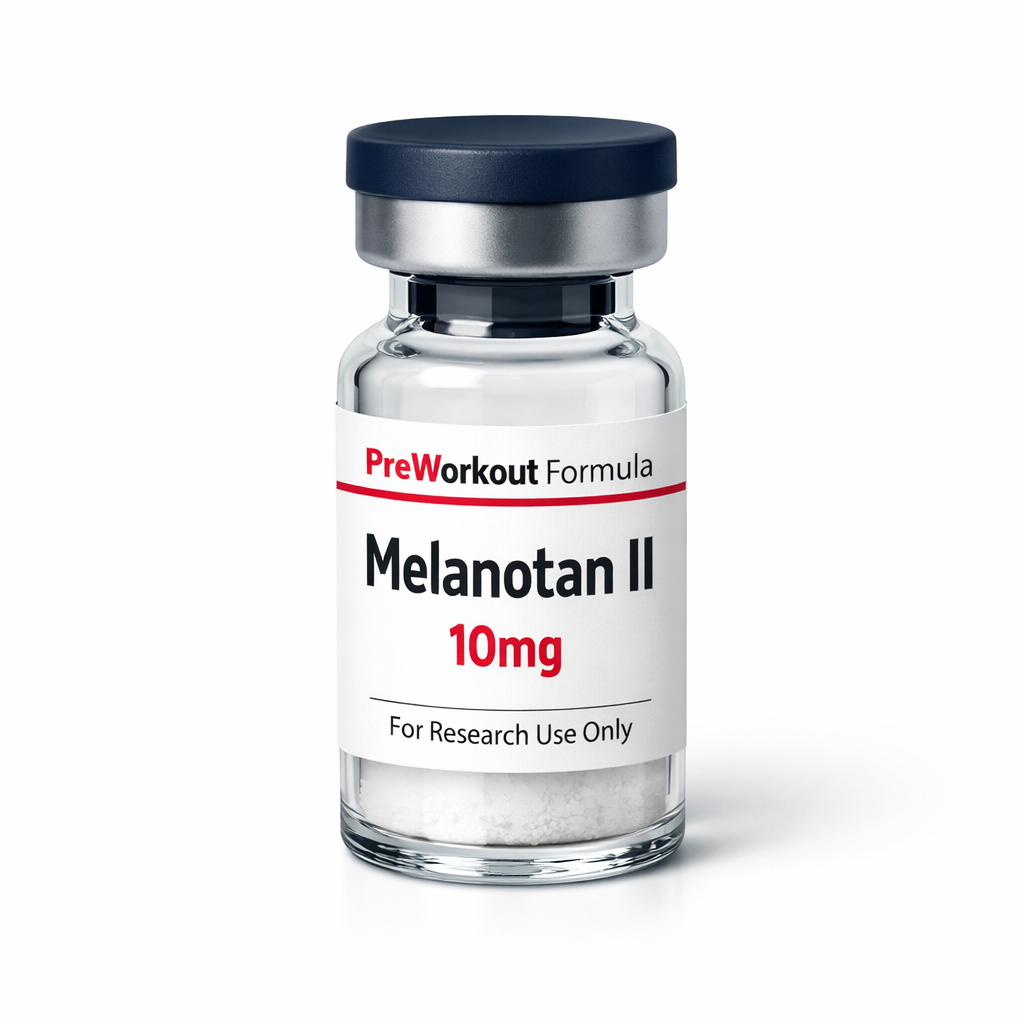
Melanotan II
$34.99
Melanotan II — research-grade cyclic melanocortin agonist. 99%+ purity, HPLC verified. 10mg lyophilized powder per vial.
Description
Melanotan II — Research Profile
Arizona Cancer Center researchers synthesized Melanotan II in the early 1990s with a specific goal: create a tanning agent that could reduce skin cancer risk by stimulating eumelanin production without UV exposure. What they got was a cyclic heptapeptide analog of alpha-MSH that activates nearly every melanocortin receptor subtype — and produces a pharmacological profile far broader than anyone anticipated. Tanning, yes. But also appetite suppression, penile erection, and measurable effects on social behavior and pair-bonding circuitry.
Melanotan II remains one of the most pharmacologically promiscuous peptides in research use. One compound, five receptor subtypes, at least four distinct physiological domains.
Receptor Pharmacology
Melanotan II is a non-selective agonist across the melanocortin receptor family:
- MC1R — melanocytes: stimulates eumelanin synthesis (tanning/pigmentation). Primary target for the original photoprotection research. Dorr et al., Life Sciences (1996)
- MC3R — hypothalamus, gut: energy homeostasis, fat partitioning, and sodium appetite regulation. Butler et al., Endocrinology (2000)
- MC4R — hypothalamus (PVN, MPOA): sexual arousal, appetite suppression, erectile function. The receptor responsible for the unexpected sexual side effects. Wessells et al., Urology (1998)
- MC5R — exocrine glands: sebaceous gland regulation, pheromone signaling in animal models. Lower research priority in peptide pharmacology
This multi-receptor profile is both a research advantage and a complication. Melanotan II can’t target melanogenesis without simultaneously activating hypothalamic appetite and sexual circuits. That lack of selectivity is why PT-141 (bremelanotide) was developed as a more MC4R-focused derivative — and why Scenesse (afamelanotide) was developed as an MC1R-focused derivative.
Research Applications by Receptor Target
Melanogenesis and Photoprotection (MC1R)
The original University of Arizona research demonstrated that Melanotan II stimulates eumelanin (brown/black pigment) production in melanocytes independent of UV radiation. Eumelanin is the photoprotective form — it absorbs UV photons and dissipates energy as heat, preventing DNA damage. Pheomelanin (red/yellow pigment) actually generates reactive oxygen species upon UV exposure. Research published in Photochemistry and Photobiology (2006) showed Melanotan II shifted the eumelanin-to-pheomelanin ratio favorably in skin biopsy samples, suggesting a mechanism for reducing UV-induced mutagenesis even before visible tanning appeared.
Sexual Function (MC4R)
Wessells and colleagues published the landmark 1998 study in Urology documenting penile erections in 8 of 10 male subjects receiving Melanotan II subcutaneously. Erections occurred without sexual stimulation — a purely pharmacological effect mediated by MC4R activation of oxytocinergic pathways descending from the hypothalamic PVN to sacral spinal cord erectile centers. This observation directly led to the development of PT-141 as a more selective sexual function compound.
Appetite and Energy Balance (MC3R/MC4R)
Central melanocortin signaling is one of the primary anorexigenic (appetite-suppressing) pathways in the brain. Melanotan II administration reduces food intake in rodent models dose-dependently — an effect abolished in MC4R knockout animals (Fan et al., Nature, 1997). The MC3R contribution appears to involve fat partitioning and energy efficiency rather than appetite per se.
Specifications
| Sequence | Ac-Nle-cyclo[Asp-His-D-Phe-Arg-Trp-Lys]-NH2 |
| Molecular Weight | 1024.18 g/mol |
| CAS Number | 121062-08-6 |
| Purity | ≥99% (HPLC verified) |
| Form | Lyophilized powder |
| Quantity | 10mg per vial |
| Storage | -20°C pre-reconstitution, 2-8°C post-reconstitution |
Published Dosing in Research Literature
The University of Arizona Phase I clinical studies used subcutaneous doses of 0.010-0.025 mg/kg. For an 80kg individual, that translates to 0.8-2.0mg per administration. Dorr’s melanogenesis studies used 0.020 mg/kg SC daily for 5-7 days to achieve measurable pigmentation changes. Wessells’ erectile function study used a single 0.025 mg/kg dose. Animal studies for appetite research have used 0.5-5.0 nmol ICV in rodent models.
A 10mg vial reconstituted in 2mL bacteriostatic water yields 5mg/mL. Onset of melanogenic effects requires multiple administrations over 5-10 days; sexual and appetite effects are typically acute and observable after a single dose.
Frequently Asked Questions
How is Melanotan II structurally related to alpha-MSH?
Alpha-MSH is a 13-amino-acid linear peptide cleaved from proopiomelanocortin (POMC). It’s the endogenous ligand for melanocortin receptors but has a plasma half-life of minutes due to rapid enzymatic degradation. Melanotan II was designed by cyclizing and modifying the core pharmacophore of alpha-MSH — specifically the His-Phe-Arg-Trp sequence responsible for receptor binding. The cyclic structure dramatically increases enzymatic resistance and extends biological activity. Norleucine replaces methionine at position 4 to prevent oxidative degradation, and D-phenylalanine replaces L-phenylalanine to enhance MC1R binding and resist chymotrypsin cleavage. The result is a much more stable and potent analog of the natural hormone.
What is the difference between Melanotan I and Melanotan II?
Melanotan I (afamelanotide, now FDA-approved as Scenesse) is a linear analog of alpha-MSH with preferential MC1R selectivity. It was designed for melanogenesis specifically and has minimal MC3R/MC4R activity — meaning it stimulates tanning without significant sexual, appetite, or behavioral effects. Melanotan II is the cyclic analog with non-selective activity across MC1-5R. Same research origin (Arizona Cancer Center), different structural approach. Melanotan I is pharmacologically cleaner for pigmentation research; Melanotan II is the broader tool for studying melanocortin system interactions across multiple receptor subtypes.
Why does Melanotan II cause nausea in research subjects?
Nausea is the most commonly reported acute side effect in human studies — occurring in roughly 50-70% of subjects at standard research doses. The mechanism involves MC4R activation in the area postrema and nucleus tractus solitarius (brainstem chemoreceptor trigger zone), regions where the blood-brain barrier is intentionally permeable to allow detection of circulating toxins. Melanocortin receptors in these regions are part of the gut-brain axis involved in satiety signaling. The nausea typically diminishes with repeated administration, suggesting receptor adaptation or desensitization in emetic circuits occurring faster than in melanogenic pathways.
Does Melanotan II-induced pigmentation look different from sun-derived tanning?
Research biopsy data shows a meaningful difference in the pigment produced. UV tanning primarily increases melanin production in existing melanosomes with a significant pheomelanin component. Melanotan II stimulates de novo melanogenesis with a higher eumelanin-to-pheomelanin ratio — particularly in individuals with fair skin (Fitzpatrick types I-II) who normally produce predominantly pheomelanin. The resulting pigmentation appears different in spectrophotometry studies: deeper brown with less of the red/orange undertone typical of UV-induced tanning in fair-skinned individuals. Barnetson et al. (JAMA Dermatology, 2006) documented these differences quantitatively.
What is the evidence for Melanotan II affecting pair-bonding or social behavior?
Emerging research, not yet definitive. MC4R activation triggers oxytocin release from the PVN — and oxytocin is a central player in social bonding, trust, and affiliative behavior. Barrett et al. (Hormones and Behavior, 2014) demonstrated that melanocortin agonists including Melanotan II influenced pair-bonding behavior in prairie vole models, a standard mammalian system for social attachment research. The effect appeared mediated through MC4R-oxytocin interactions rather than sexual arousal per se. This is a newer research area with a thin but provocative evidence base.
Can Melanotan II stimulate existing moles or nevi?
MC1R is expressed on nevus melanocytes, and melanocortin signaling can stimulate melanin production in these cells just as in normal melanocytes. Case reports in dermatology literature have documented darkening of existing nevi during Melanotan II use. Clinically, this is relevant because changes in nevus appearance are a primary screening criterion for melanoma. Whether Melanotan II-induced nevus changes are purely cosmetic (increased melanin in stable cells) or could promote malignant transformation in predisposed nevi is an open research question without definitive human data.
Related Research Peptides
For MC4R-focused research, see PT-141 (Bremelanotide) — developed directly from Melanotan II for selective sexual function pathways. Kisspeptin intersects reproductive axis signaling at the GnRH level. DSIP and AOD-9604 offer neuroendocrine and metabolic research applications respectively. Full catalog at peptides for sale.
For research and laboratory use only. Not for human consumption. All peptides are sold strictly as research chemicals.